
This analysis comes from Trophy, the gamification infrastructure powering more than a million users, which gives us a direct view into how gamification productivity apps retain people over time.
Per Trophy's Gamification Intelligence Report 2026, Wednesday (not Friday) sees the most streak losses at 21.1%, with Sunday the safest day at 6.7%. For fitness or language apps, that is explained by weekend schedule disruption. For productivity apps, the mechanism is different: the work week ends, external structure disappears, and the habit that depended on that structure breaks with it. Productivity is the app category where gamification is most likely to work exactly as intended during the week and fail completely at the weekend. Designing around that pattern is one of the more tractable problems in consumer product development.
| Day of Week | Streak Loss Share (%) |
|---|---|
| Monday | 7.07 |
| Tuesday | 12.04 |
| Wednesday | 17.74 |
| Thursday | 13.91 |
| Friday | 25.35 |
| Saturday | 19.07 |
| Sunday | 4.83 |
N.B. Wednesday is the highest-loss day for streaks, accounting for 21.1% of all breaks — more than any other weekday — with Friday next at 18.5% and Sunday lowest at 6.7%, according to Trophy's Gamification Intelligence Report 2026.
This post covers eight productivity apps that approach gamification differently, with a specific lesson from each one about what their design choices reveal.
If you're evaluating APIs to build these mechanics yourself, start with our guide to the best gamification APIs for developers.
At-A-Glance: Gamification Productivity Apps Compared
Here is each app paired with its core mechanic and the single design lesson it demonstrates, drawn from the analysis below.
| App | Core Mechanic | Key Lesson |
|---|---|---|
| Todoist | Karma points and levels for task completion | Reward metrics that resist gaming, or users optimize for volume over meaningful work. |
| Habitica | RPG mechanics with punishment (lost hit points) | Punishment suits users who have already committed, not those still forming a habit. |
| Beeminder | Commitment contract with a financial stake | Real stakes resist gaming but narrow the user base to those who want them. |
| StickK | Commitment contract with a human referee | Social obligation changes behavior more reliably than algorithmic tracking. |
| Forest | Loss aversion through a growing (or dying) tree | Loss aversion is only as strong as the perceived value of what is at stake. |
| TickTick | Habit tracker, Pomodoro timer, and task manager combined | Layering reinforcing mechanics gives users more reasons to return. |
| SuperBetter | Collaborative ally and quest mechanics | Collaborative social features outperform competition for emotionally significant behavior. |
| Streaks | Minimalist streak count with no extra layers | Minimalism builds early habits; richer systems retain the long tail. |
Todoist: The Karma System And The Proxy Metric Problem
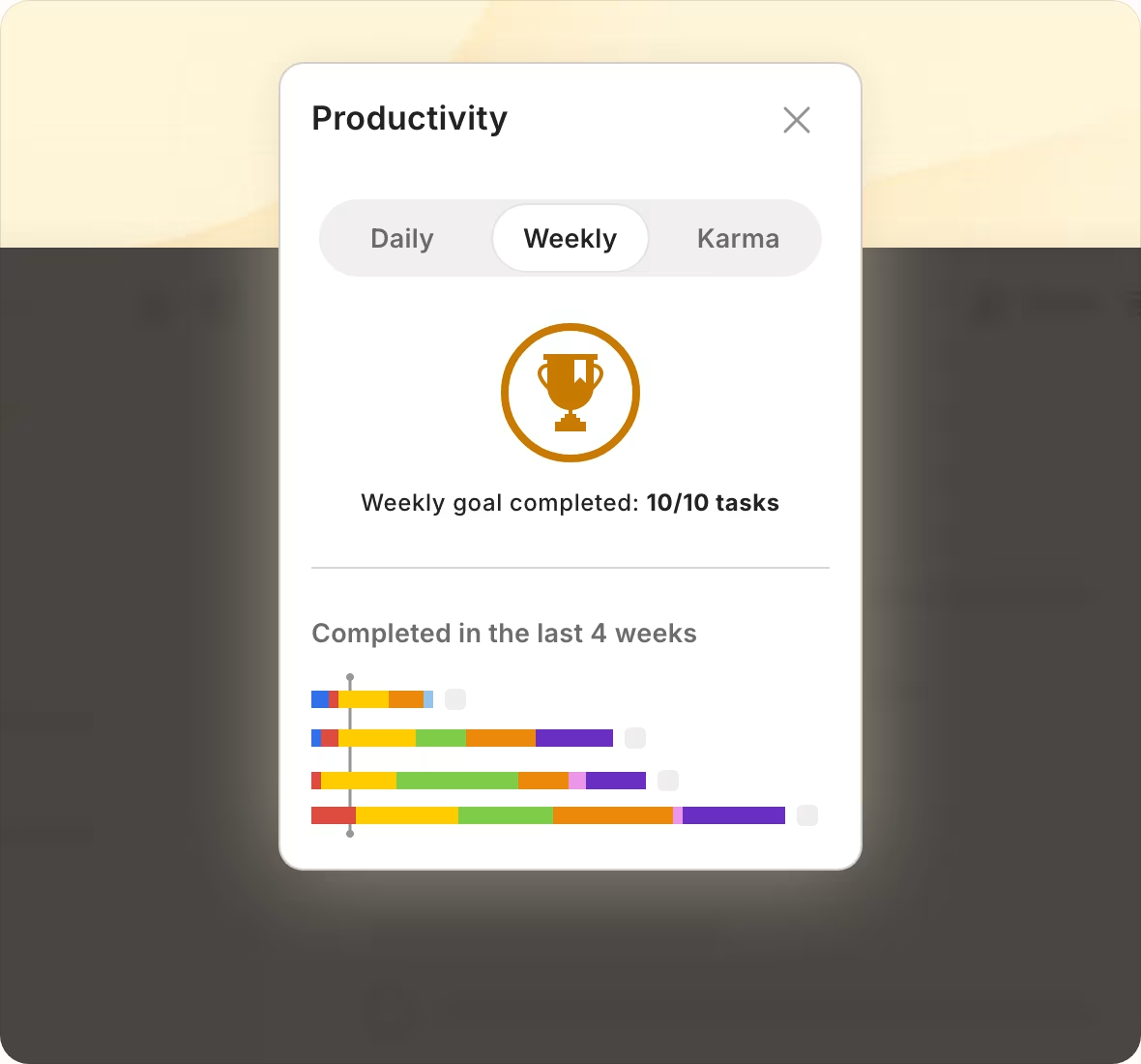
Todoist awards Karma points for completing tasks, maintaining streaks, and using the app consistently. Users advance through levels (Beginner through Enlightened) as their score climbs. The system is thoughtfully built and genuinely motivating for a large portion of Todoist's user base.
It also has a well-documented failure mode. Karma rewards task completion regardless of task importance, which means the fastest path to a higher score is completing a high volume of small, easy tasks rather than fewer, meaningful ones. Users who discover this optimize for it, not always consciously. The inbox fills with two-minute items, important projects sit untouched, and the Karma number climbs while actual productivity declines.
Trophy's platform data illustrates the pattern from a different angle. Users with daily streaks in the fifteen-to-thirty-day bucket show average daily activity volumes more than three times higher than users in the eight-to-fourteen-day bucket, which suggests that sustained engagement genuinely correlates with higher output, not just more sessions. The risk in a Karma-style system is that it severs that connection, rewarding session frequency and task count rather than the depth of engagement that produces real outcomes.
| Streak Length | Daily Activity Volume |
|---|---|
| 3-7 | 265.27 |
| 8-14 | 353.22 |
| 15-30 | 1090.05 |
N.B. Daily activity volume is measured as the users total metric value within each 24hr window.
The lesson is that the metric being rewarded needs to be resistant to gaming. Points systems can work well for productivity apps when they reward the right actions. Todoist's Karma works well for users who do not optimize for it. For the subset who do, the gamification layer becomes a distraction from the product's actual purpose.
Habitica: What Punishment Mechanics Cost You
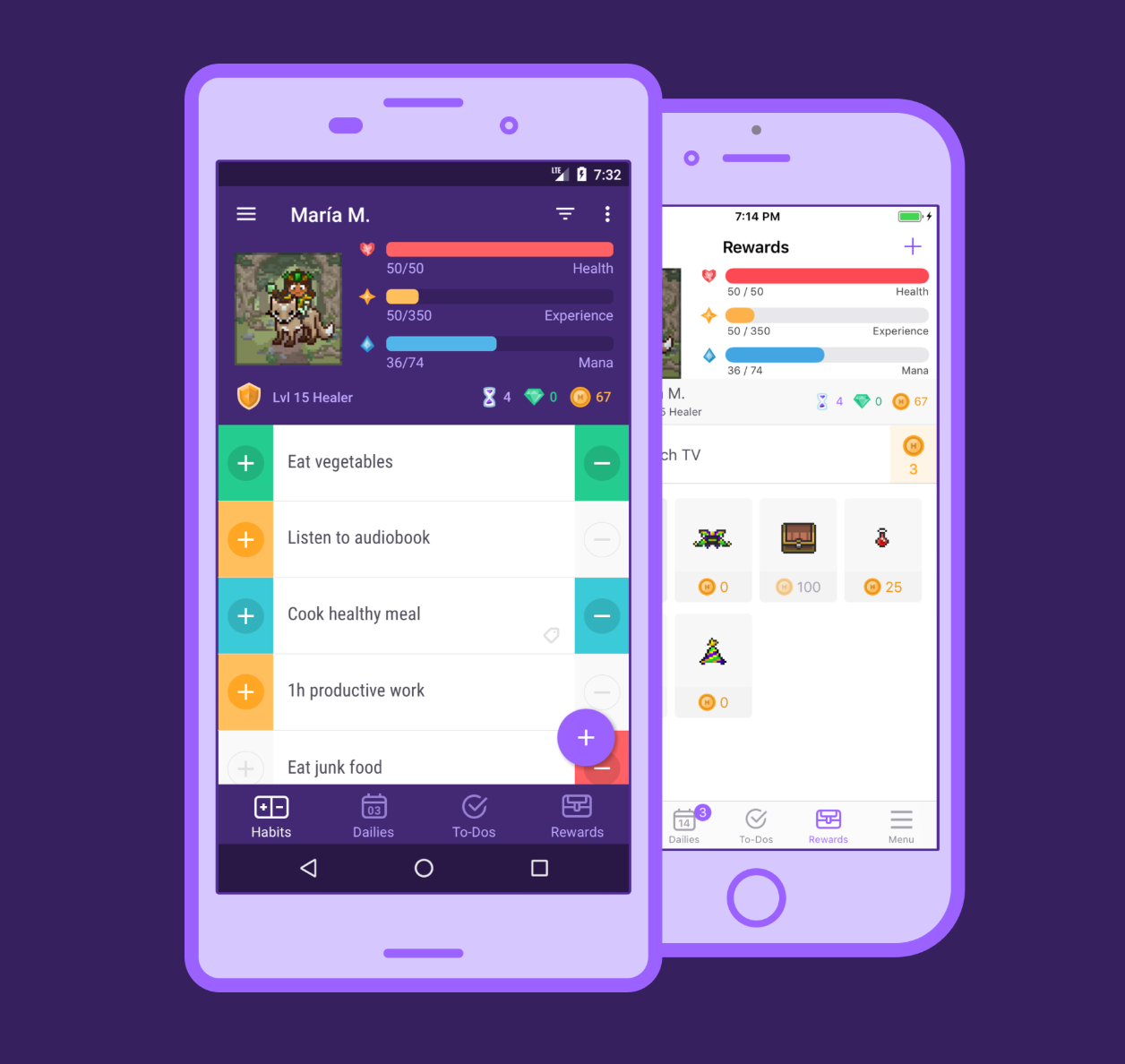
Habitica turns habit and task management into a role-playing game. Users create characters, complete quests, join parties, and earn gear. It is one of the most fully realized gamification systems in any consumer app, and it uses a mechanic that almost no other productivity tool touches: punishment alongside reward. Failing to complete a daily task forfeits an XP gain and reduces your character's hit points, and enough missed tasks can kill your character outright.
This is a genuine design choice with a real psychological basis. Anticipated loss is a stronger motivator than anticipated gain for many people, and Habitica's system activates that loss aversion in a way that pure reward systems cannot. For users who respond to it, the mechanic is highly effective.
The problem surfaces in the return rate data. Trophy's latest data confirms the same pattern: the longer the streak lost, the more likely a user returns. Trophy's 2026 platform data shows return rate rising from roughly a third to nearly three-quarters depending on streak length lost. These numbers reflect apps without punishment mechanics, so the actual return rates for Habitica after a character death are likely lower still. When the failure state is severe enough to feel definitive (your character is dead, your progress is erased), users who were already struggling are more likely to quit than restart.
| Streak Length | Users Returned (%) |
|---|---|
| 2-3 | 0.90 |
| 4-7 | 1.42 |
| 8-14 | 1.54 |
| 15-30 | 2.49 |
| 31-60 | 9.09 |
| 61+ | 100.00 |
Punishment mechanics are better suited to users who have already demonstrated commitment than to users still in the early habit formation window. Habitica's party system partially addresses this by making failure social rather than purely individual, which changes the emotional register of a miss from personal defeat to letting down your team. That is a more recoverable failure state, and it is probably why Habitica's social features are more central to its retention than the punishment mechanics alone.
Beeminder: The Commitment Contract Model
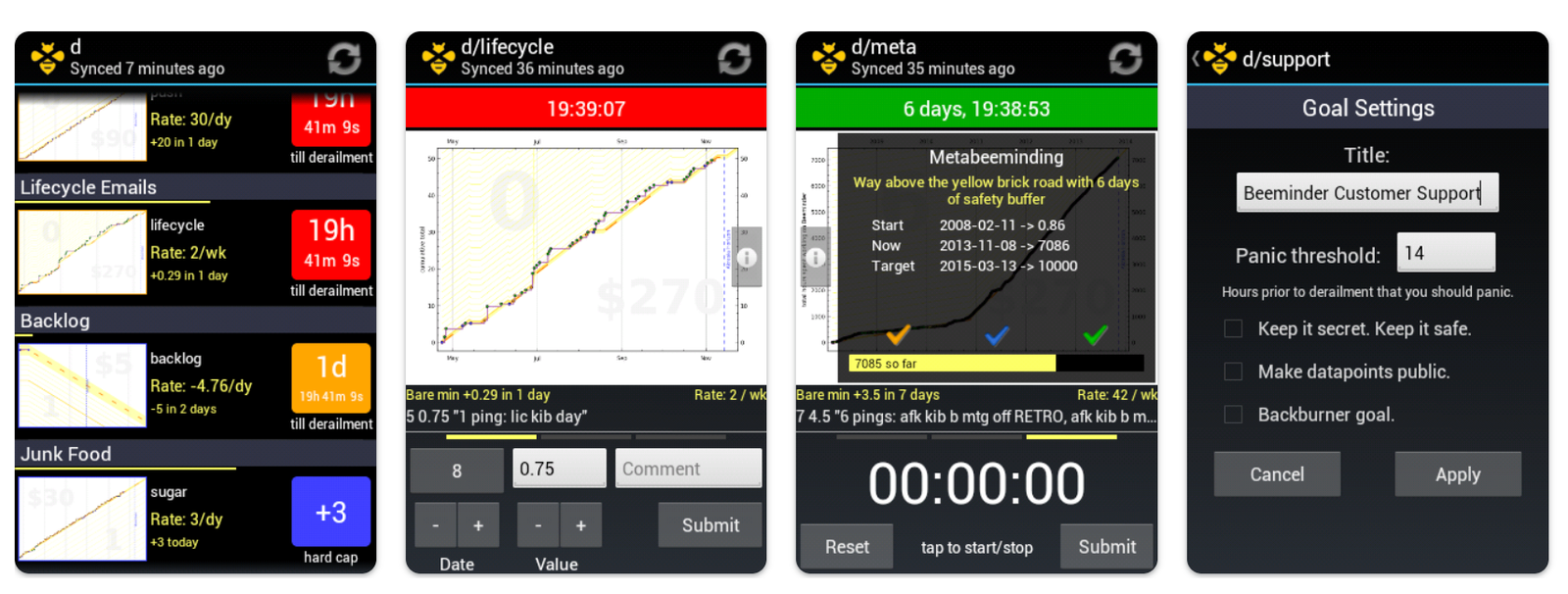
Beeminder operates on a different principle from every other app in this post. Users commit to a goal and set a financial stake, and if they fail to stay on their progress track, real money is charged to the card on file. The app tracks progress on a graph, and the red "derailment line" makes it visually clear at all times how close a user is to paying out.
This design sidesteps the proxy metric problem entirely. You cannot game a Beeminder commitment by completing easier tasks or logging partial credit, because the goal is defined in advance and the consequences are real. The accountability mechanism is external and financial rather than internal and psychological, which makes it far more resistant to rationalization.
The trade-off is that the user base self-selects aggressively. Users who find financial stakes motivating stay; everyone else leaves quickly. Beeminder's retention curve likely looks very different from Todoist's, with a steeper early drop-off but much higher long-term retention for the users who stay. This is a legitimate product strategy, but it means Beeminder's gamification model is not broadly transferable. The commitment contract works because both the goal and the consequences are taken seriously. Applied to a general-purpose task manager, most users would simply delete the app rather than accept financial risk for missed to-dos.
StickK: Social Accountability As The Primary Mechanic
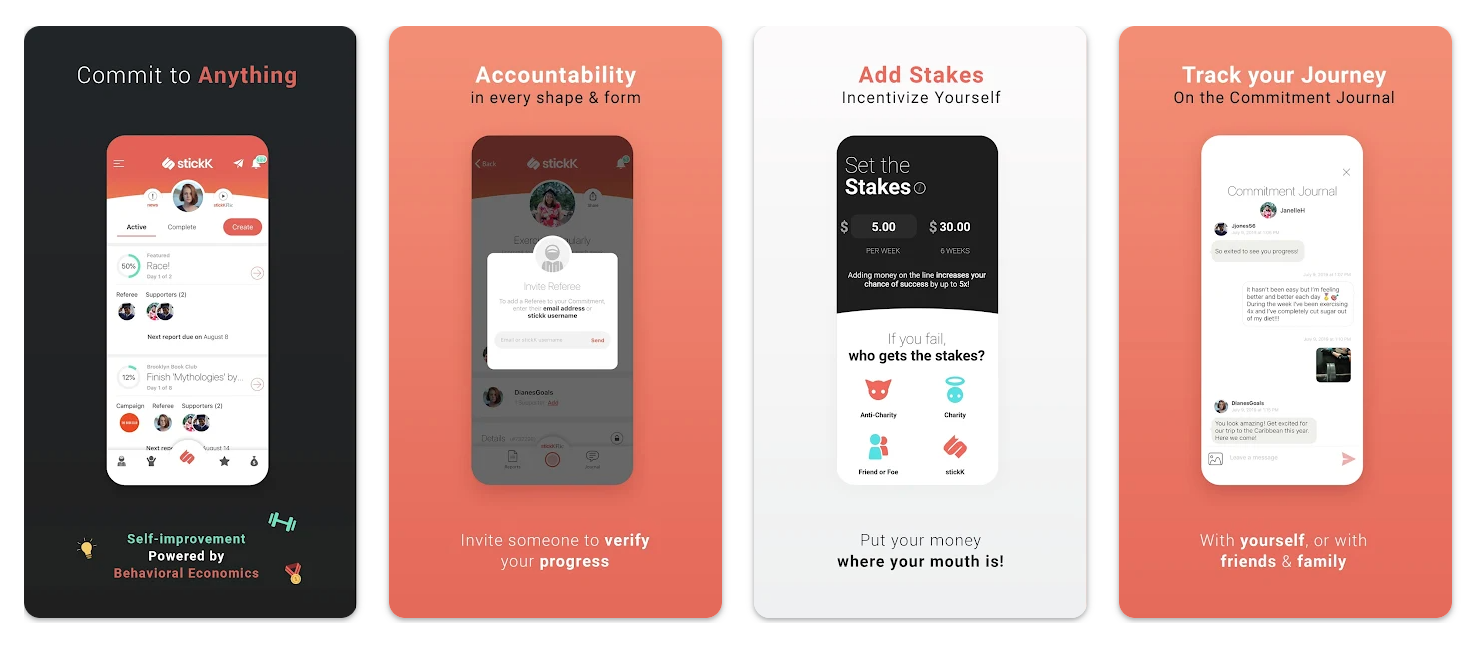
StickK uses a similar commitment contract model to Beeminder but adds a layer that changes the psychology significantly: a human referee. Users designate someone (a friend, a colleague, a professional accountability coach) who monitors their progress and reports on whether the terms of the contract are being met. The financial stake is still present, but the social accountability layer is what most users cite as the primary motivator.
This maps closely to what Trophy's platform data shows about social features and streak survival. Apps with visible leaderboards see meaningfully more competitive engagement: Trophy's 2026 data shows repeating leaderboards run 3.4x more competitive than perpetual ones. StickK's referee model is essentially a manual, high-stakes version of the social accountability that streak leaderboards create automatically. The mechanism is different, but the underlying psychology is the same: knowing that another person is watching changes behavior more reliably than knowing that an algorithm is tracking it.
| Leaderboard type | Displacement (users overtaken) | Winner retention (next day) |
|---|---|---|
| Perpetual | 5.4% | 91.2% |
| Repeating | 18.2% | 11.3% |
The lesson for product teams is that social accountability and competitive social features are not the same thing. Leaderboards create competition. A referee or accountability partner creates obligation. Both improve retention, but they activate different motivations and suit different user types. Apps that offer both have a broader retention toolkit than those that rely on one or the other.
Forest: Reframing What Loss Aversion Means
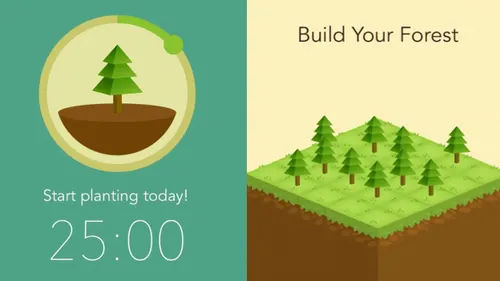
Forest is a focus timer disguised as a nurturing game. Users plant a virtual tree at the start of a focus session, and the tree grows for as long as they stay off their phone. If they leave the app before the session ends, the tree dies. Completed trees accumulate into a forest that grows alongside the user's focus history.
The gamification mechanic is loss aversion in a specific register. Losing a Todoist streak means a number resets. Losing a Forest tree means something you were caring for is gone. The emotional weight is different, and for a meaningful segment of users, it is more motivating than a counter. Forest also partners with a real tree-planting organization, so coins earned through focus sessions can fund actual tree planting, which adds a prosocial dimension that no other productivity app in this list offers.
What Forest gets right is that the thing being lost feels worth protecting. This is a design principle rather than a mechanic: the loss aversion in any gamification system is only as strong as the perceived value of what is at stake. A number resetting feels minor. A living thing dying feels worse. The practical implication for product teams is that the visual and emotional framing of a streak or progress metric shapes how much users care about maintaining it, independent of the underlying reward structure.
TickTick: What A Comprehensive Implementation Looks Like
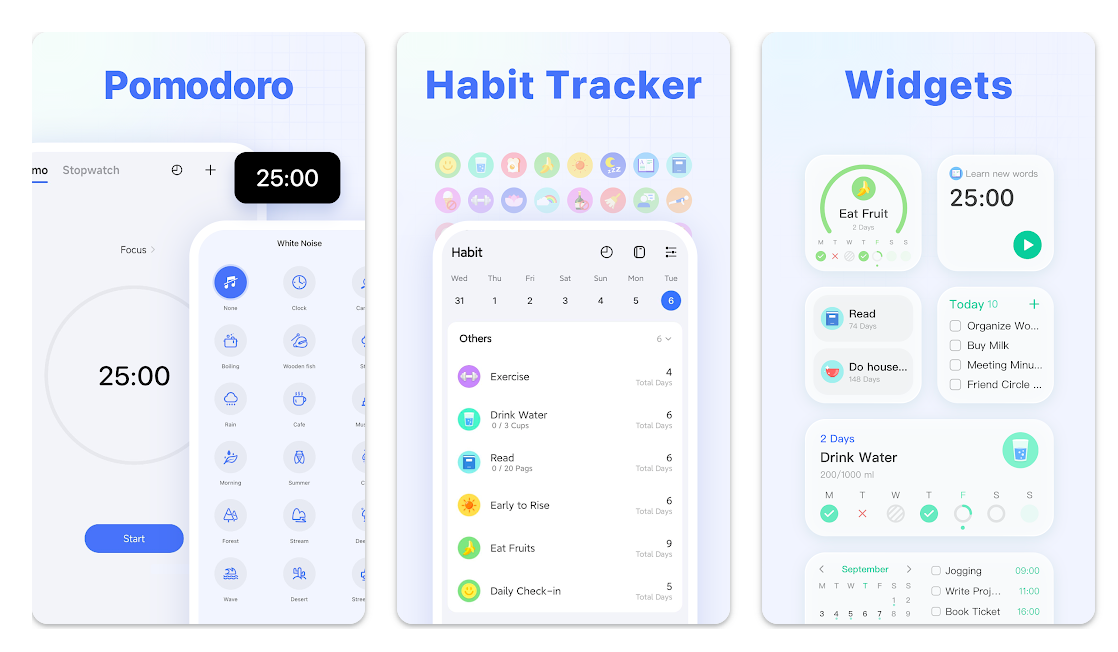
TickTick combines a habit tracker, a Pomodoro focus timer, and a full task manager in a single product, with gamification elements woven through all three. Habit streaks are tracked and displayed per habit. Focus sessions accumulate toward daily goals. Points and badges reward consistent use. The result is one of the more complete gamification implementations in any consumer productivity app.
Two aspects of TickTick's implementation are worth noting specifically. The first is the Pomodoro integration. Pairing a time-boxing mechanic with streak tracking creates a loop where focus sessions feed into daily habit completion, which feeds into streaks. Each component reinforces the others, and a user who engages with all three has significantly more reasons to open the app than a user engaging with just one.
The second is timing. Productivity apps are acutely exposed to the end-of-week loss pattern in Trophy's data. Per Trophy's latest platform data, Wednesday overtook Friday as the highest streak-loss day. Trophy's 2026 gamification benchmark data puts Wednesday at the top for streak losses. For a productivity app, this translates directly into a notification strategy: Thursday reminders before the Friday risk window, and a Sunday re-engagement message for users who broke over the weekend.
Trophy's platform data also shows that daily streak users on apps with freeze functionality average 17.19 days on streak past the seven-day mark, compared to 11.62 days for those without. For a productivity app where consistent daily use is the core value proposition, that gap is significant enough to justify offering a grace period for missed days.
| Streak Length | Avg (Without Freezes) | Avg (With Freezes) |
|---|---|---|
| >7 days | 11.62 | 17.19 |
| >14 days | 18.87 | 30.63 |
SuperBetter: Social Mechanics For High-Friction Behavior Change
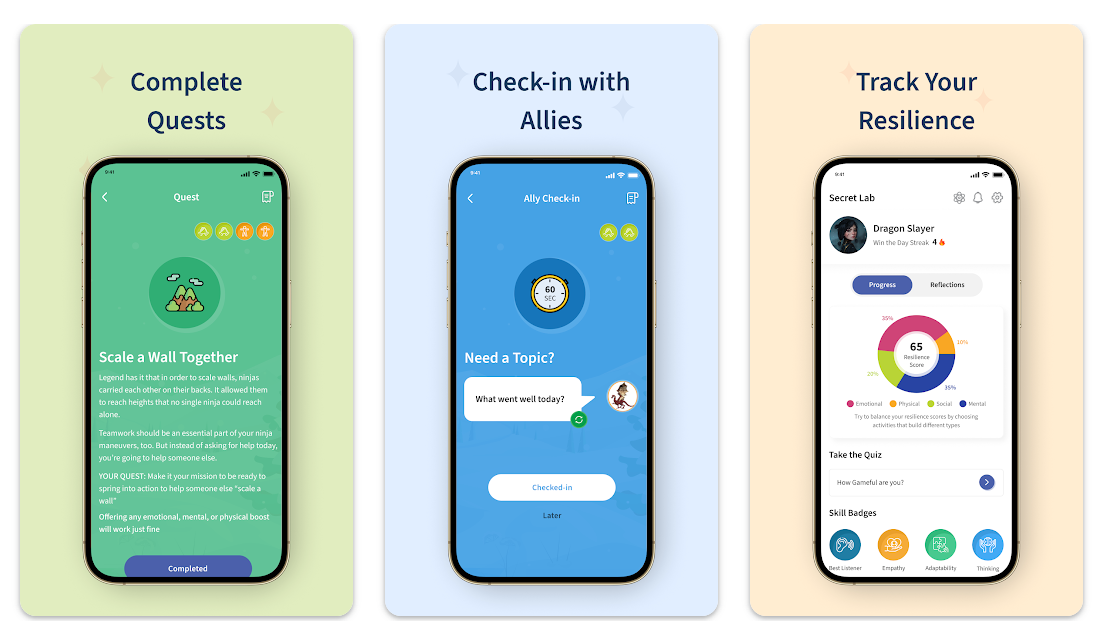
SuperBetter was designed to build resilience and support mental health, helping users stay motivated in the face of change and difficult challenges. It frames goal pursuit as a quest, obstacles as challenges to overcome, and support from others as power-ups. The gamification layer is more elaborate than most productivity apps, and the social component is central rather than supplementary.
The social mechanic is worth examining specifically. SuperBetter users can add allies (friends or family members who join their quest, send power-ups, and receive updates on progress). The mechanic is collaborative and supportive rather than competitive like a leaderboard. The accountability it creates is closer to StickK's referee model than to Todoist's Karma system.
Trophy's 2026 platform data shows the same social-visibility mechanism on leaderboards: repeating leaderboards run 3.4x more competitive than perpetual ones. SuperBetter's ally mechanic likely produces a stronger effect than a streak leaderboard would, because the social obligation is personal and explicit rather than anonymous and competitive.
For product teams building in categories where the behavior being tracked is emotionally significant (recovery, mental health, major life change), collaborative social mechanics are likely to outperform competitive ones.
Streaks: Minimalism As A Design Position
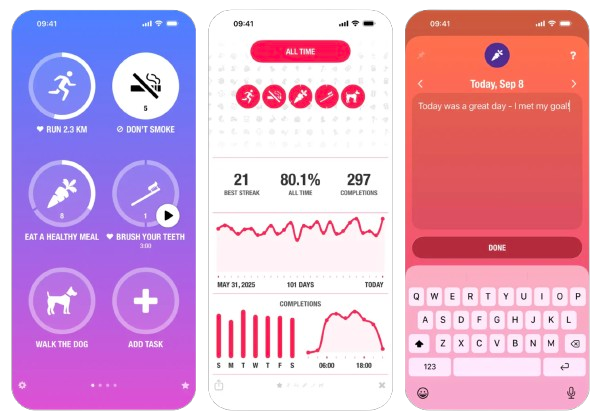
The app simply called Streaks does one thing: it tracks up to twelve tasks and whether you complete them each day. There are no points, no levels, no social features, no leaderboard. The interface is clean to the point of austerity. The gamification is limited to the streak count itself and a circular progress indicator that fills as daily tasks are completed.
This is a deliberate design position rather than a limitation. Streaks' thesis is that most gamification systems add complexity that competes with the habit they are meant to support. Every extra mechanic is a decision the user has to make and a cognitive load they have to carry. Reducing the system to its minimal viable form (did you do the thing today, yes or no) removes that overhead and keeps the focus on the behavior rather than the game.
The counter-argument, from Trophy's data, is that more complex systems with social features and freeze functionality do produce longer streaks on average. The median daily streak across Trophy's platform is four days regardless of complexity, but the tail of the distribution (the users with thirty, sixty, ninety-day streaks) is disproportionately found in apps with richer mechanic sets. Minimalism works well for building habits in the first two weeks. Beyond that, the additional retention levers available in more complex systems start to matter.
What Trophy's Data Shows About Productivity Gamification
Several patterns emerge when productivity app gamification is examined through platform data rather than individual product examples.
Productivity is the category most vulnerable to the proxy metric problem. In a fitness app, you cannot easily fake a run. In a language app, lesson completion is a reasonable proxy for learning. In a productivity app, task completion is highly gameable: users can populate their lists with low-effort items and maintain a streak or Karma score while avoiding the work that actually matters. Any points or streak system in a productivity context should be configured to weight meaningful actions (project milestones, deep work sessions, completed priorities) more heavily than task volume.
Friday is the highest-risk day, and it is specifically a productivity problem. Per Trophy's latest platform data, Wednesday overtook Friday as the highest streak-loss day. Fitness apps lose users at the weekend because schedules change. Productivity apps lose users on Friday because the external structure that drives weekday engagement disappears at end-of-day. A Thursday notification, sent before the risk window opens, is the simplest structural intervention, and it is one that very few productivity apps currently use in a targeted way.
Short streak breaks almost never recover without intervention. Per Trophy's Gamification Intelligence Report, longer lost streaks predict a much higher chance of coming back. For a productivity app where users are often trying to build a new routine from scratch, this means the first week is make-or-break. In this context, streak freeze availability, grace periods, and early milestone acknowledgement at days three, five, and seven decide whether a user forms a habit or churns on their second Thursday.
Social accountability outperforms competition for behavior change in this category. Leaderboards and competitive mechanics work well in fitness and social apps. For productivity, where the behaviors being tracked are often personal and tied to professional or life goals, collaborative accountability (a partner, a shared progress view, a check-in mechanic) tends to produce stronger retention than competition does. StickK's referee and SuperBetter's ally system are manual implementations of what social streak features provide automatically.
Frequently Asked Questions
Do gamified productivity apps actually work?
Trophy's own platform data says yes, when the mechanics are designed well. Apps with resettable, visible leaderboards see real behavioural lift: top-10% rankings turn over 8x more often on repeating leaderboards than on perpetual ones, per Trophy's 2026 platform data. Apps with freeze functionality keep users on streak for 17.19 days past the seven-day mark, compared to 11.62 days without. These first-party figures come from the gamification infrastructure powering more than a million users. Well-configured mechanics measurably extend how long people sustain a habit.
What is gamification in productivity apps?
Gamification in productivity apps is the use of mechanics borrowed from games, such as points, streaks, levels, badges, and challenges, to increase engagement and retention. The goal is to make consistent, high-effort behavior more rewarding by attaching progress signals and loss aversion mechanics to the behaviors the app is trying to encourage. In productivity specifically, the challenge is designing these mechanics so they reward meaningful work rather than easily gamed proxies like task volume or login frequency.
Which gamification mechanic works best for productivity apps?
Streaks are the most widely used and generally effective mechanic for building daily habits in productivity apps, because they create loss aversion that compounds over time. For deeper behavior change or goal pursuit, commitment contracts (where a financial or social stake is attached to follow-through) are more resistant to rationalization. Points and levels work well as supplementary mechanics but need to be configured to reward meaningful actions rather than volume, or they create the proxy metric problem Todoist's Karma system illustrates.
What is the proxy metric problem in productivity gamification?
The proxy metric problem occurs when the behavior a gamification mechanic tracks is a means to an end rather than the end itself, and the mechanic makes it easy to satisfy the proxy without achieving the actual goal. In Todoist, completing a high volume of small tasks earns Karma faster than completing fewer important ones, so some users optimize for Karma rather than productivity. The solution is to weight gamification events by the quality or importance of the action, not just its occurrence, or to use commitment contracts, which tie the stake to the actual goal rather than a trackable proxy.
Why do productivity app streaks break most often on Fridays?
Trophy's 2026 gamification benchmark data puts Wednesday at the top for streak losses. For productivity apps specifically, the mechanism is likely the loss of external work-week structure: the routine that drove daily engagement during the week disappears at the end of the working day on Friday, and without that structure the habit breaks. Trophy's Gamification Intelligence Report 2026 confirms Wednesday, not Friday, is now the peak day for streak breaks. A Thursday reminder, sent before the risk window opens, is the most targeted intervention available without requiring changes to the product's core mechanics.
How do streak freezes affect long-term retention in productivity apps?
Significantly. Daily streak users on apps with freeze functionality average 17.19 days on streak past the seven-day mark, compared to 11.62 days for those without, across Trophy's platform. For productivity apps targeting habit formation, this gap matters most in the first two to four weeks, the window where a new routine is most vulnerable to disruption. A grace period for a single missed day reduces the chance that one bad Friday ends a streak the user was genuinely invested in maintaining.
Should productivity apps use competitive leaderboards or collaborative social features?
The evidence favors collaborative features for most productivity use cases. Trophy's 2026 platform data shows leaderboards are typically the mechanic that manufactures competitive pressure — repeating leaderboards run 3.4x more competitive than perpetual ones — but productivity apps rarely want that pressure. The social dynamic that works for productivity apps is accountability and shared obligation rather than competition. Leaderboards work well in fitness and social apps where users want to compare performance. For productivity, where goals are personal and often tied to professional stakes, a partner mechanic or progress-sharing feature tends to produce stronger long-term retention than a competitive ranking.
How do I add gamification to a productivity app with Trophy?
Trophy's Streaks API, Points API, and Achievements API can be configured independently or in combination, with custom metric weighting, freeze and grace period logic, and notification scheduling built in. The docs cover full integration. For a productivity-specific implementation, the configuration decisions covered in this post (metric weighting, freeze availability, Thursday notification triggers) are worth addressing before the first line of integration code is written. You can book a demo to talk through your specific use case.
Conclusion
The apps above represent a range of approaches to the same underlying challenge: making consistent, effortful behavior more likely to continue. The ones that hold up over time share a common trait: the gamification layer is designed around the realistic constraints of the behavior it is tracking, including when it is most likely to break and why.
For productivity apps, that means accounting for the end-of-week structure collapse, protecting early streak survival before loss aversion has had time to activate, and ensuring that the metrics being rewarded actually correspond to the outcomes users came for. A well-configured system addresses all three. Most out-of-the-box implementations address none of them.
For a broader look at how streak mechanics work across app categories, see our analysis of how the best apps use streaks and what Trophy's platform data shows about design decisions that determine whether a streak survives. For gamification beyond productivity apps, see our cross-industry roundup.
Get the latest on gamification
Product updates, best practices, and insights on retention and engagement — delivered straight to your inbox.
The gamification layer for consumer apps
Drop-in gamification features you can ship this sprint. Increase retention and user engagement without sacrificing your roadmap.
 Book a call