Quick answer
The best customer engagement platform for a consumer app depends on one choice: do you want to build and maintain journeys, or have AI run lifecycle messaging for each user? We compared 12 platforms on how each decides what to send, what your team writes and maintains, how uplift is measured, pricing and security.
Trophy is focused on consumer web and mobile apps, so it fits teams that want AI lifecycle marketing agents working for each user individually, delivering the right messages at the right time without journeys or templates. It isn't the pick if your program depends on SMS or WhatsApp today, or if your team wants to draw every path on a canvas.
Top picks
| Tool | Best for |
|---|---|
| Trophy | Consumer apps that want an AI lifecycle marketing agent to decide, time and write each email and push for each user |
| Sequenzy | Small teams that want an affordable, AI-native tool for email, push and in-app messages |
| Braze | Enterprise CRM teams running large journey programs across many channels |
Book a demo to see if Trophy's AI lifecycle marketing agents can outperform your current setup.
Choosing a customer engagement platform for a consumer app
Most consumer app teams describe the same problem: users sign up, try the product a few times and drift away, and the messages meant to bring them back feel generic. A customer engagement platform decides who gets which email, push notification or in-app message, and when.
Search for customer engagement software, tools or solutions and you'll also find support desks and sales tools. This list covers lifecycle messaging for consumer web and mobile apps only. Many of these platforms also serve retailers, banks and software companies, so we note which are built around consumer apps.
Why trust us
We build Trophy, the 1:1 customer engagement platform for consumer web and mobile apps, so this is the problem we work on every day, and consumer apps are our focus. Trophy powers customer engagement for more than 1M users, at companies such as RevisionDojo, an AI study platform for 350,000 students, and Campfire, where over 1M authors write. Our in-app experiences lifted 14-day retention by 9% at RevisionDojo and by 22% at Campfire, and that work is why we know these platforms (Trophy's customers).
We put Trophy first because we think it's the best fit for many consumer apps, and each section says where another tool fits better.
Leal measured Trophy's in-app experiences against a control group in its first pilot:
Trophy helped us put [in-app experiences] in front of our merchants without building [the engine behind them] ourselves. In our first pilot in Panama, the dynamics lifted redemption rate by 22% against the control group.
 Emiliano AristizábalHead of Product, Leal
12 best customer engagement platforms compared
| Tool | Best for | How it decides what to send | Templates written in | How uplift is measured | Pricing basis | Security |
|---|---|---|---|---|---|---|
| Trophy | Consumer apps that want AI to run lifecycle messaging | An AI lifecycle marketing agent for each user, trained on consumer app behavior, decides, times and writes each message | No templates to write | Holdout | Three plans; pricing provided as part of a demo | SOC 2 Type II, ISO 27001 |
| Sequenzy | Small teams on a budget | Event-based flows; AI drafts emails you approve | AI-drafted emails you edit | Email-to-revenue attribution | Per email sent; free tier; from $19/month | None listed on its home page |
| Braze | Enterprise CRM teams | Canvases; AI builds them and picks among team-supplied options | Liquid | Global control group | By quote | SOC 2 Type II, ISO 27001 |
| MoEngage | Suites with AI decisioning | Flows; AI picks among team-written variations | Jinja | Control groups | By quote | SOC 2 Type II, ISO 27001 |
| CleverTap | Mobile apps wanting analytics | Journeys; decisioning add-on on Ultimate | Liquid | Control groups | From $85/month | SOC 2 Type II, ISO 27001 |
| JustAI | Adding AI testing to current sends | Agents pick among shared versions for each person | Versions you or its AI write | Holdout | Not published | None listed on its home page |
| Iterable | An independent Braze-like platform | Journeys; Nova Decisioning | Handlebars | Ask the vendor | By quote | SOC 2 Type II, ISO 27001 |
| Customer.io | Published prices, event-driven | Workflows; AI Agent (beta) helps build | Liquid | A/B tests | From $100/month | SOC 2 Type II, ISO 27001 |
| OneSignal | A free, push-first start | Journeys; Intelligent Delivery | Liquid | A/B tests | Free; Growth from $19/month plus usage | Not stated on its pricing page |
| Airship | App-first brands | Journeys; testing tunes timing and content | Handlebars | Testing tools | By quote; self-serve Essentials | Shows a SOC 2 logo |
| Insider One | Enterprise retail | Journeys; Agent One plans campaigns | Liquid (early access) | Ask the vendor | All-inclusive fee | SOC 2 Type II, ISO 27001 |
| PostHog Workflows (for PostHog users) | Teams on PostHog | Rule-based workflows | Liquid | Ask the vendor | 10,000 emails free, then per email | SOC 2 Type II |
Checked on each vendor's site between 25 and 28 November 2026; confirm details with the vendor.
The 12 platforms in detail
1. Trophy
Best for: consumer web and mobile apps that want an AI lifecycle marketing agent working for each user instead of journeys and templates Pricing: three plans (Pro, Business and Enterprise). Pricing for Pro, Business and Enterprise is provided as part of a demo. Channels: email, push and in-app experiences
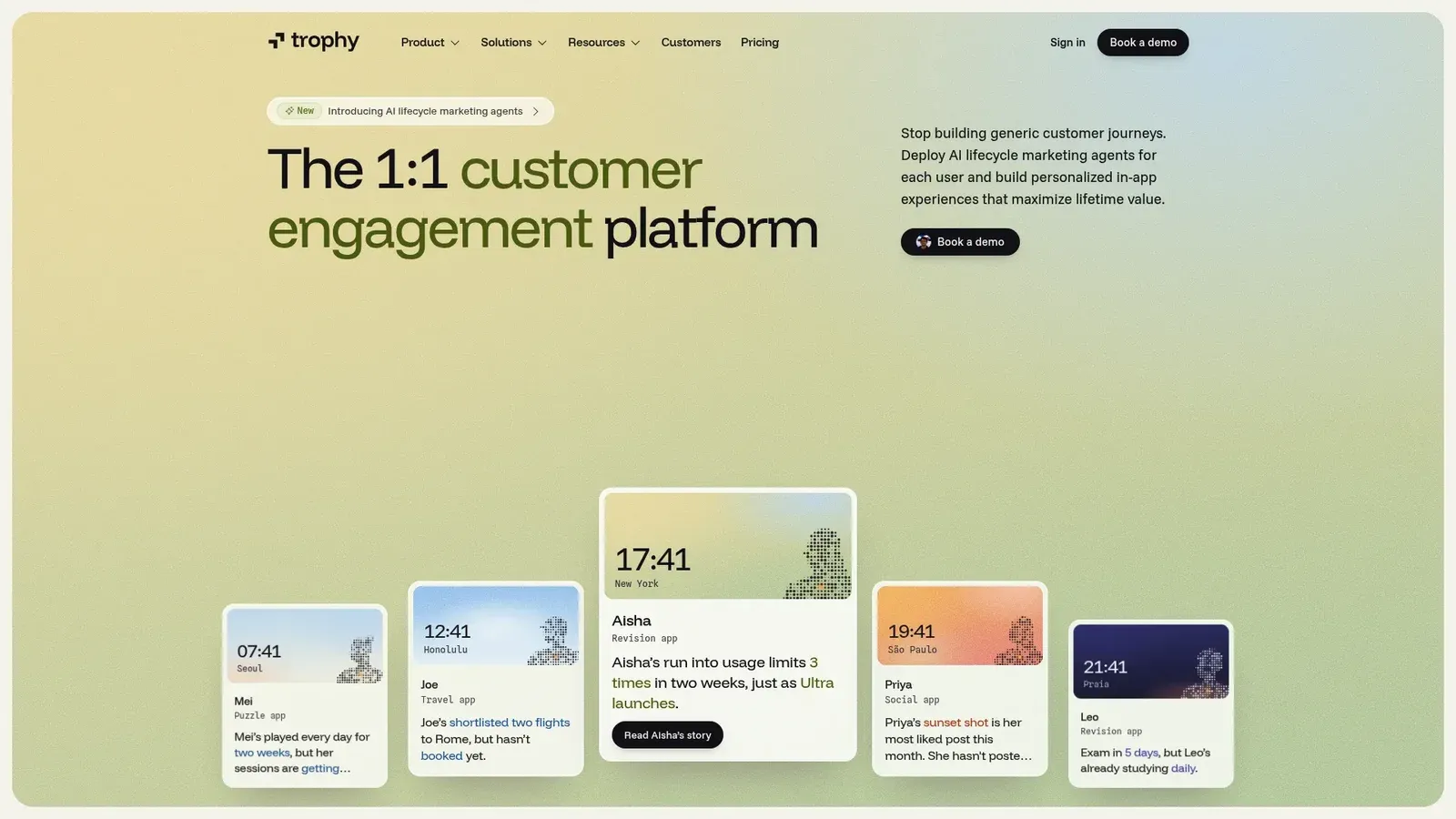
Trophy's home page. Source: Trophy, captured November 2026.
We build Trophy, the 1:1 customer engagement platform for consumer web and mobile apps. Trophy runs an AI lifecycle marketing agent for each of your users. Each one reads that user's in-app activity, decides whether a message is worth sending, picks email or push and the best timing, and writes the message itself. There are no journeys or templates, so there's no Liquid or other template code to write or review. Because Trophy is focused on consumer apps, its decisioning is trained on the use cases and behavior patterns of consumer platforms, then learns from how each of your users responds. Its in-app experiences (milestones, streaks, points, leaderboards and rewards) are built around the habits consumer apps depend on, and they give the AI lifecycle marketing agents first-party data about each user.
Your team stays in control through objectives rather than journeys: activation, engagement, conversion or retention, with the outcomes that matter most weighted by what they're worth. A brand kit sets the voice, the images to use and the phrases and topics never to use, and you cap messages per user per week and per month. Emails send from your domain and push notifications through your own FCM, APNs or Expo setup. Results show against a holdout that never receives messages from the AI lifecycle marketing agents, starting with a pilot. See how Trophy works with marketing teams, or how Trophy is different from other customer engagement platforms.
Every branch and template in a journey is a rule someone set up, so anything the builder wasn't designed for becomes a workaround: another branch, more template code or a second tool. Trophy's AI lifecycle marketing agents reason about each user instead, so a new requirement is something you tell them, much as you'd brief a colleague.
Key features
- An AI lifecycle marketing agent for each user that decides, times and writes each email and push.
- Working with the people who build Trophy: a shared Slack channel, integrations built with you and weekly KPI reporting.
Pros
- AI lifecycle marketing agents, lifecycle email, push and in-app experiences are included on every plan rather than sold as add-ons.
- Focused on consumer apps, from the decisioning models to the in-app experiences.
- Uplift shows in retention and other KPIs against a holdout, not just in opens.
What reviewers say: Trophy holds a 4.8 out of 5 rating from seven reviews on G2 (November 2026).
Is Trophy right for your team?
- AI lifecycle marketing agents replace journeys, so teams that want to draw every path themselves will prefer Braze or Iterable.
- It's focused on consumer apps, so B2B software teams will find Customer.io or Sequenzy a closer fit.
- Trophy supports email, push and in-app experiences. If SMS or WhatsApp is central, look at Braze, MoEngage or Insider One alongside it.
- Your engineers send the events you already track, once, and Trophy builds the integrations with you; after that, marketing runs it.
- Trophy is SOC 2 Type II and ISO 27001 certified. Business adds SSO, MFA and role-based access; Enterprise adds multi-tenancy, data residency and a custom SLA (Trophy's plans).
Book a demo to test Trophy's AI lifecycle marketing agents against your current setup on a share of your users.
2. Sequenzy
Best for: small teams that want an affordable, AI-native tool for email, push and in-app messages Pricing: per email sent, with unlimited contacts: free up to 2,500 emails a month, paid plans from $19 a month for 15,000 emails. SMS and MMS add $16 a month. Channels: email; web, iOS and Android push; in-app modals, banners and cards; SMS and MMS (add-on, in beta)
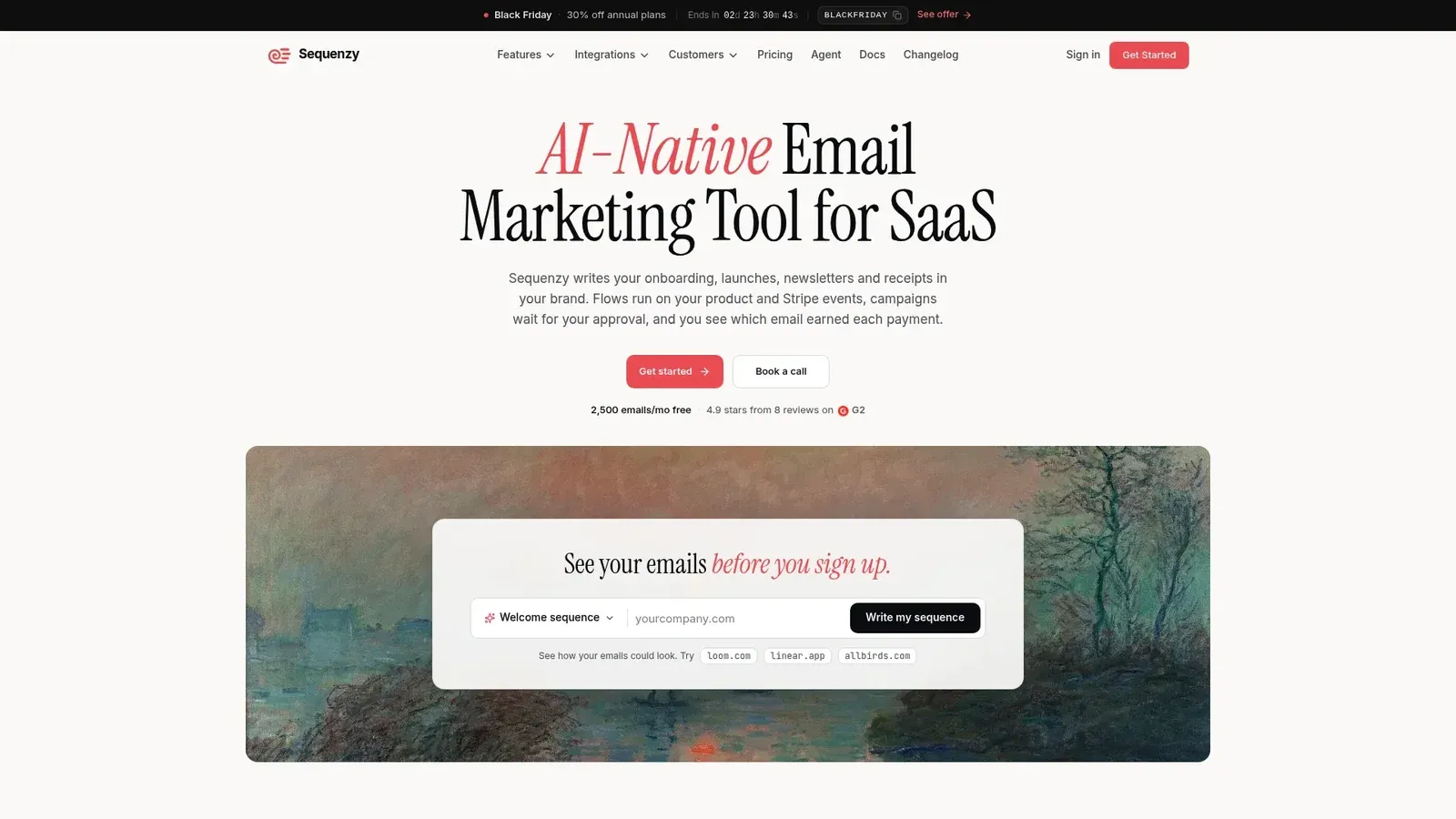
Sequenzy's home page. Source: Sequenzy, captured November 2026.
Sequenzy is an AI-native platform that writes your emails in your brand: point it at your website and it drafts onboarding sequences, launch emails, newsletters and receipts with your logo, colors and voice. Flows run on product and billing events, campaigns wait for your approval, and Sequenzy attributes email performance to revenue outcomes. Web, iOS and Android push and in-app modals, banners and cards are unlimited on every plan, including the free one.
For a team that has looked at Braze and wants its core channels without an enterprise contract, Sequenzy is the affordable alternative. It's priced on emails sent rather than contacts or monthly active users, so quiet users don't raise the bill. Its home page positions it for SaaS companies, so check how its push and in-app features fit your app before you commit.
Key features
- AI that drafts every email in your brand, edited section by section on request.
- Email, push and in-app on every plan, with unlimited contacts and email-to-revenue attribution.
Pros
- Published prices that start free and stay low for small teams.
- Billing on emails sent, not stored contacts.
Cons
- Flows run on rules your team sets up; the AI writes the copy rather than deciding for each user whether or when to send.
- SMS and MMS are a paid add-on, in beta, and its home page doesn't list a security certification such as SOC 2 Type II.
What reviewers say: Sequenzy holds a 4.9 out of 5 rating from eight reviews on G2 (November 2026).
Choose Sequenzy if you're a small team that wants email, push and in-app in one affordable tool, with AI drafting the copy and published prices. Choose Trophy instead if you're a consumer app that wants AI lifecycle marketing agents to decide, time and write each message for each user, with uplift measured against a holdout.
3. Braze
Best for: enterprise CRM teams running large programs across many channels Pricing: by quote: a platform edition, monthly active users and a pool of Action Credits that email, SMS and some AI features draw on. Channels: email; push; SMS, MMS and RCS; WhatsApp, LINE and KakaoTalk; in-app messages, banners and Content Cards
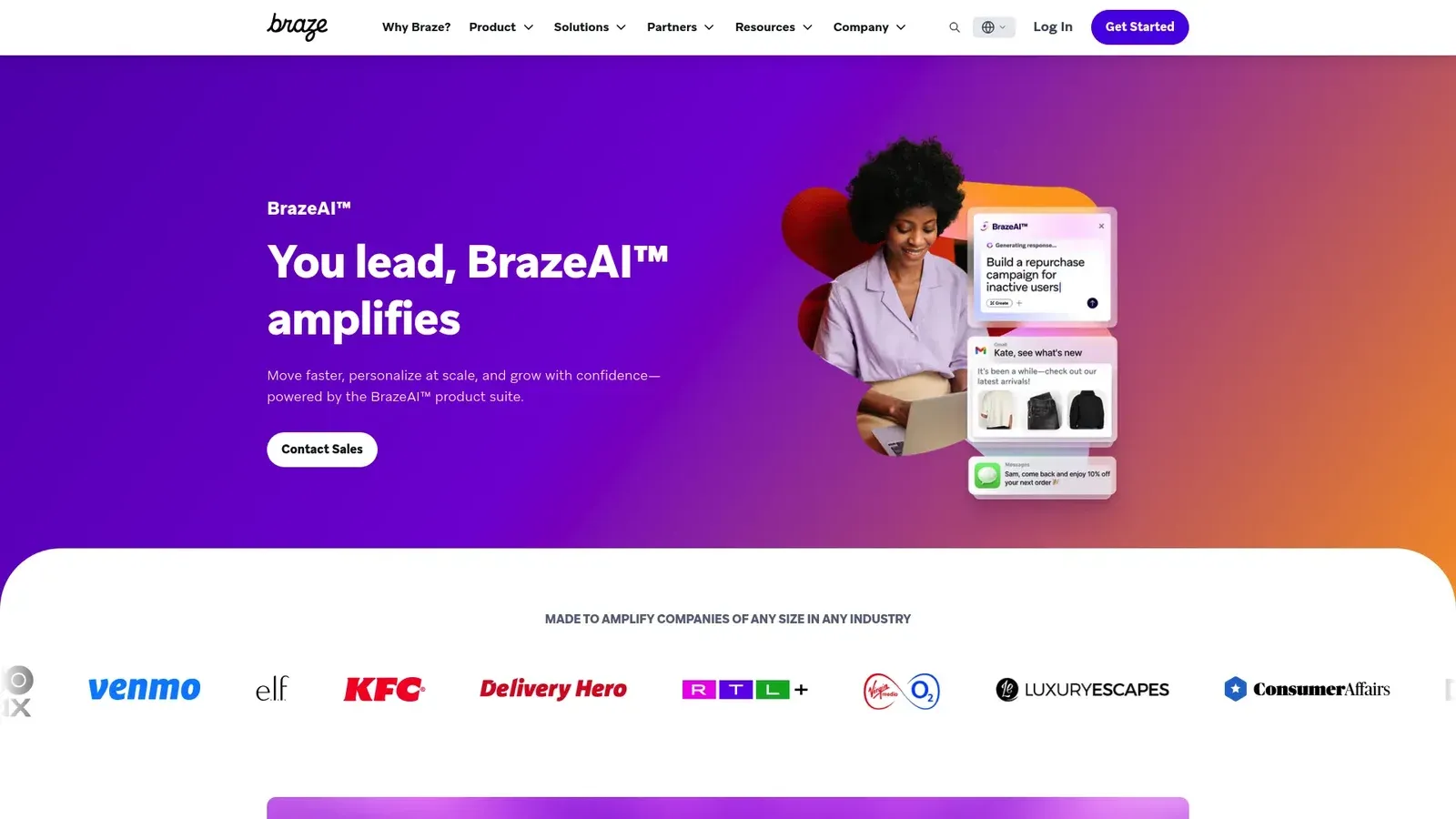
BrazeAI product page. Source: Braze, captured November 2026.
Braze is the platform most consumer app teams already know, built around Canvases: journeys a team designs and maintains. BrazeAI adds layers on top: Operator builds content, campaigns and Canvases from a prompt; Braze Agents run as steps inside a Canvas and, by Braze's own docs, don't learn from whether their output worked; and Decisioning Studio chooses among the content, offers and actions the team makes available. Messages are written in Liquid.
The biggest change is ownership. Salesforce agreed to acquire Braze on 20 October 2026, with closing expected in Salesforce's fiscal 2028.
Key features
- Canvases with testing and frequency capping.
- BrazeAI: Operator, Braze Agents and Decisioning Studio.
Pros
- Depth for large CRM teams, with one of the longest channel lists here.
- Lists SOC 2 Type II and ISO 27001.
Cons
- Personalization beyond a name is Liquid code to write and maintain.
- The bill has many separately priced parts: edition, users, credits, add-ons and services.
What reviewers say: 4.5 out of 5 from about 2,000 reviews on G2; 4.7 from 168 on Capterra UK.
An IT services reviewer gave Braze five stars for value:
Braze provides excellent value for money given its depth of features.
A small-business campaign manager gave it two stars, crediting its AI orchestration but finding personalization code-heavy:
…it still relies on manual Liquid code for routine dynamic personalization.
Choose Braze if a dedicated CRM team runs large journey programs across many channels and the acquisition doesn't change your plans. Choose Trophy instead if you're a consumer app that wants AI to run lifecycle messaging for each user, rather than more Canvases to build.
More on Braze: Trophy vs Braze · Braze alternatives · Braze pricing
4. MoEngage
Best for: consumer brands that want journeys, analytics and AI decisioning in one suite Pricing: by quote: Growth or Enterprise plans billed on monthly tracked users, plus add-ons such as AI agents and AI decisioning. Channels: mobile and web push, email, SMS, in-app and on-site messages; WhatsApp, RCS and other connected channels as add-ons
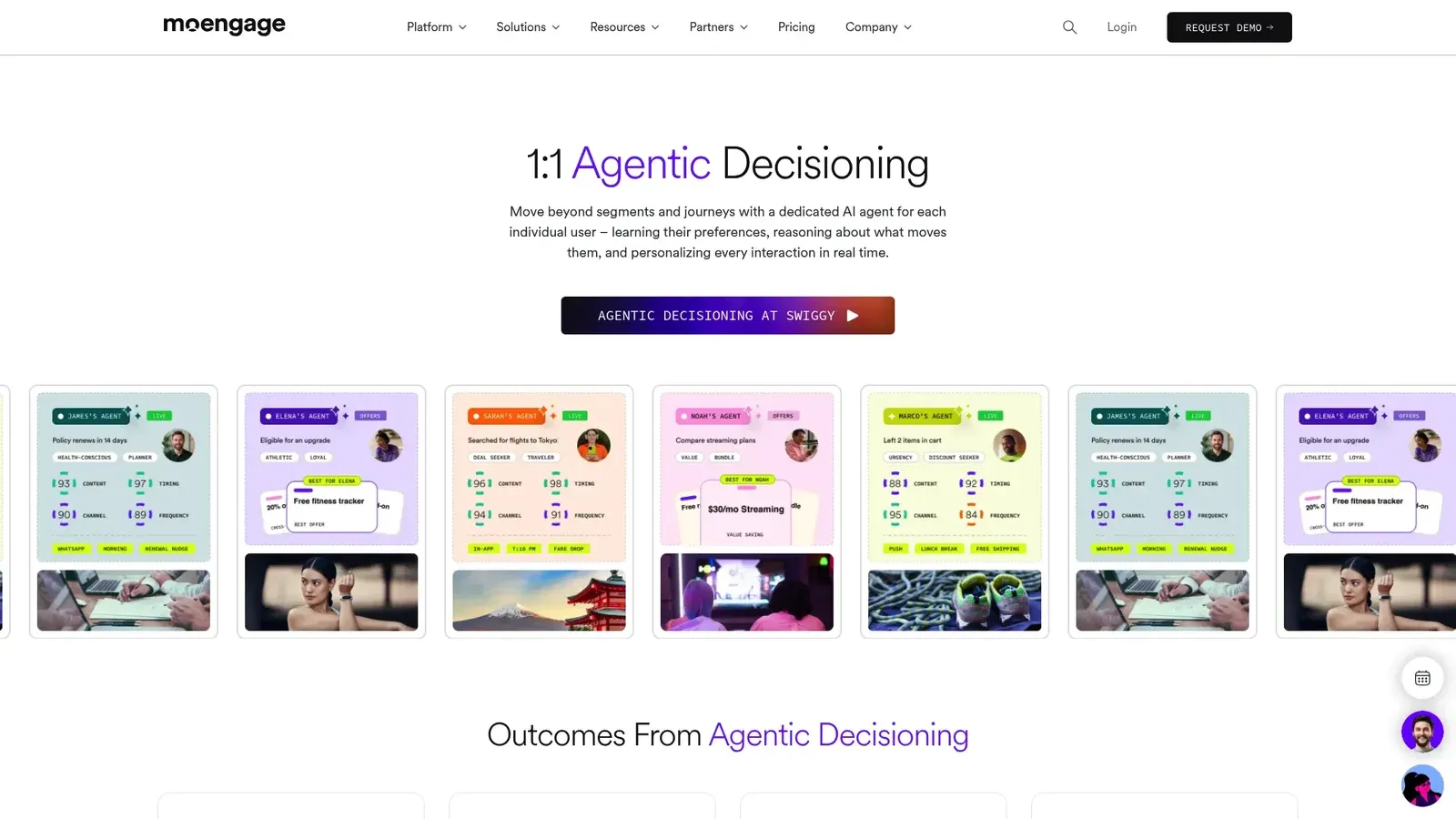
MoEngage's agentic decisioning page. Source: MoEngage, captured November 2026.
MoEngage calls itself an agentic customer engagement platform. Flows is its journey builder, and in June 2026 it acquired Aampe, whose reinforcement learning gives each user an agent that learns which options work for that person. That per-user learning is a real step beyond A/B tests. What it personalizes is the choice: with AI Campaign Decisioning, the team creates several complete message variations and the policy picks one for each user (push only, in early access as of November 2026). The copy itself is shared, written by the team or generated once with Merlin AI. Merlin AI agents prepare campaign drafts for a person to publish, and MoEngage sells a maker-checker approval workflow.
Key features
- Flows for cross-channel journeys, with campaign and global control groups.
- AI Campaign Decisioning and Merlin AI for copy and campaign drafts.
Pros
- Journeys, analytics and AI decisioning from one vendor.
- A long certification list, including SOC 2 Type II and ISO 27001.
Cons
- Personalization is written in Jinja.
- AI agents, decisioning and several channels are add-ons.
- Decisioning picks among shared variations rather than writing for each user.
What reviewers say: 4.5 out of 5 from 535 reviews on G2.
A mid-market IT services reviewer gave MoEngage 4.5 stars for its visual journey builder:
Campaign journeys can be built visually, which helps understand how users move across touchpoints.
A retention specialist gave it 3.5 stars, citing fewer templates than expected and add-on costs:
…for many useful features I have to pay extra money.
Choose MoEngage if you want journeys, analytics and per-user decisioning over your team's message variations in one suite. Choose Trophy instead if you want each message written for the person receiving it, not chosen from a shared set.
More on MoEngage: Trophy vs MoEngage · MoEngage alternatives · MoEngage pricing
5. CleverTap
Best for: mobile-first teams that want product analytics and engagement in one tool Pricing: Core from $85 a month for up to 5,000 monthly active users; Pro and Ultimate through a demo. Channels: push, in-app, app inbox, web push and web pop-ups included; email, SMS, WhatsApp and RCS as add-ons
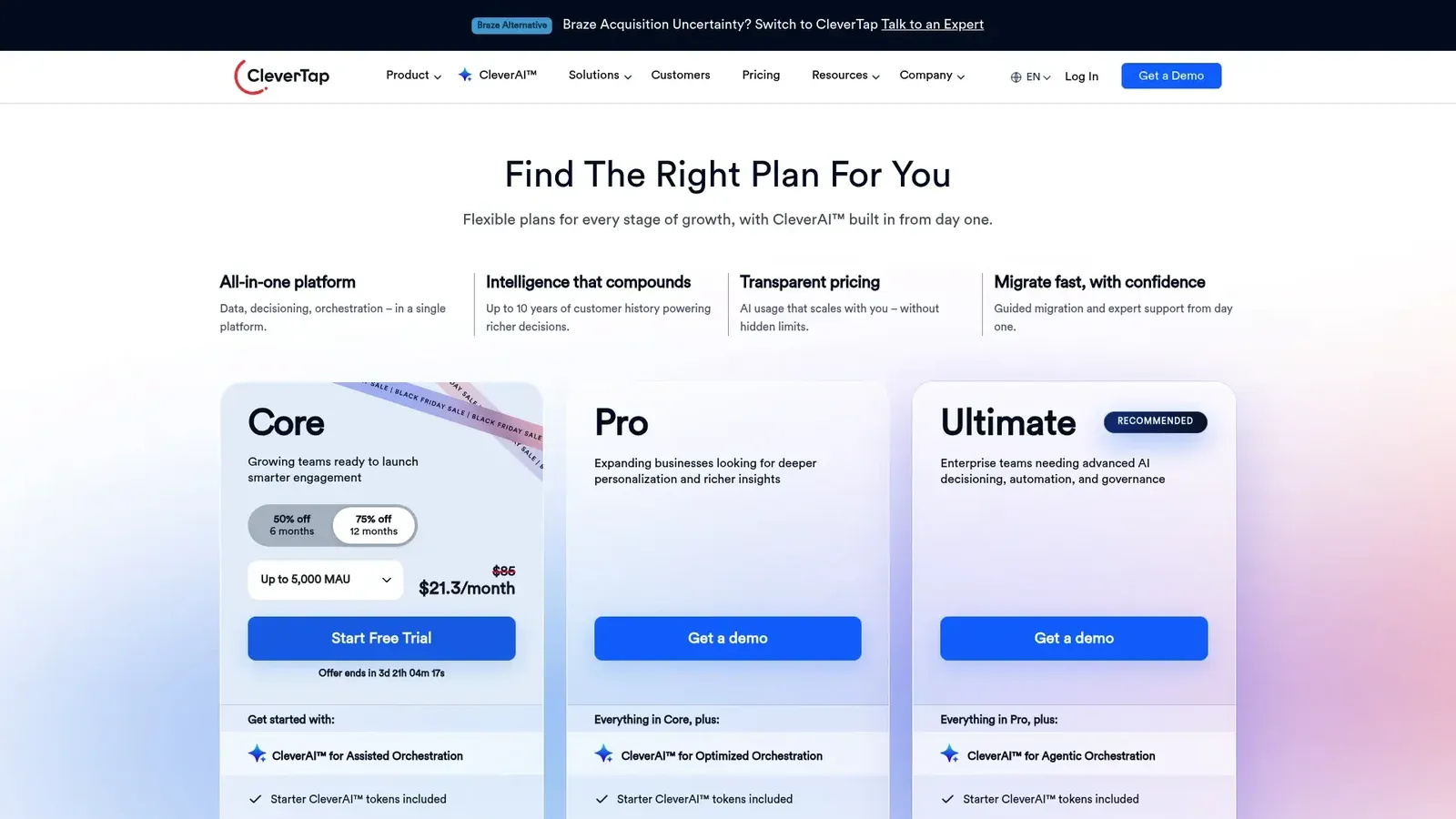
CleverTap's pricing page. Source: CleverTap, captured November 2026.
CleverTap pairs engagement with built-in behavioral analytics: funnels, cohorts and trends. Journeys and control groups are included. Its Decisioning Agents for campaigns, variants and lifecycle are an add-on available on Ultimate. Email is an add-on on every plan, and messages use Liquid tags.
Pros
- Analytics included, and a published entry price.
- Lists SOC 2 Type II and ISO 27001.
Cons
- Email and AI decisioning cost extra.
- Personalization logic is written in Liquid.
What reviewers say: 4.4 out of 5 from 68 reviews on Capterra UK.
A games reviewer gave CleverTap five stars for its features and easy journeys:
CleverTap has so much functionality, I especially like the ease of use of journeys…
An education reviewer, also at five stars, flagged one weakness:
The push notification delivery rates in CleverTap are somewhat low for Android devices…
Choose CleverTap if you want analytics and engagement in one mobile-first tool with a published starting price. Choose Trophy instead if you want AI lifecycle marketing agents included on every plan, writing each message rather than running journeys.
6. JustAI
Best for: lifecycle teams that want AI to test and choose sends across email, push, SMS and in-app Pricing: not published; sold through a demo Channels: email, push, SMS, in-app and landing pages
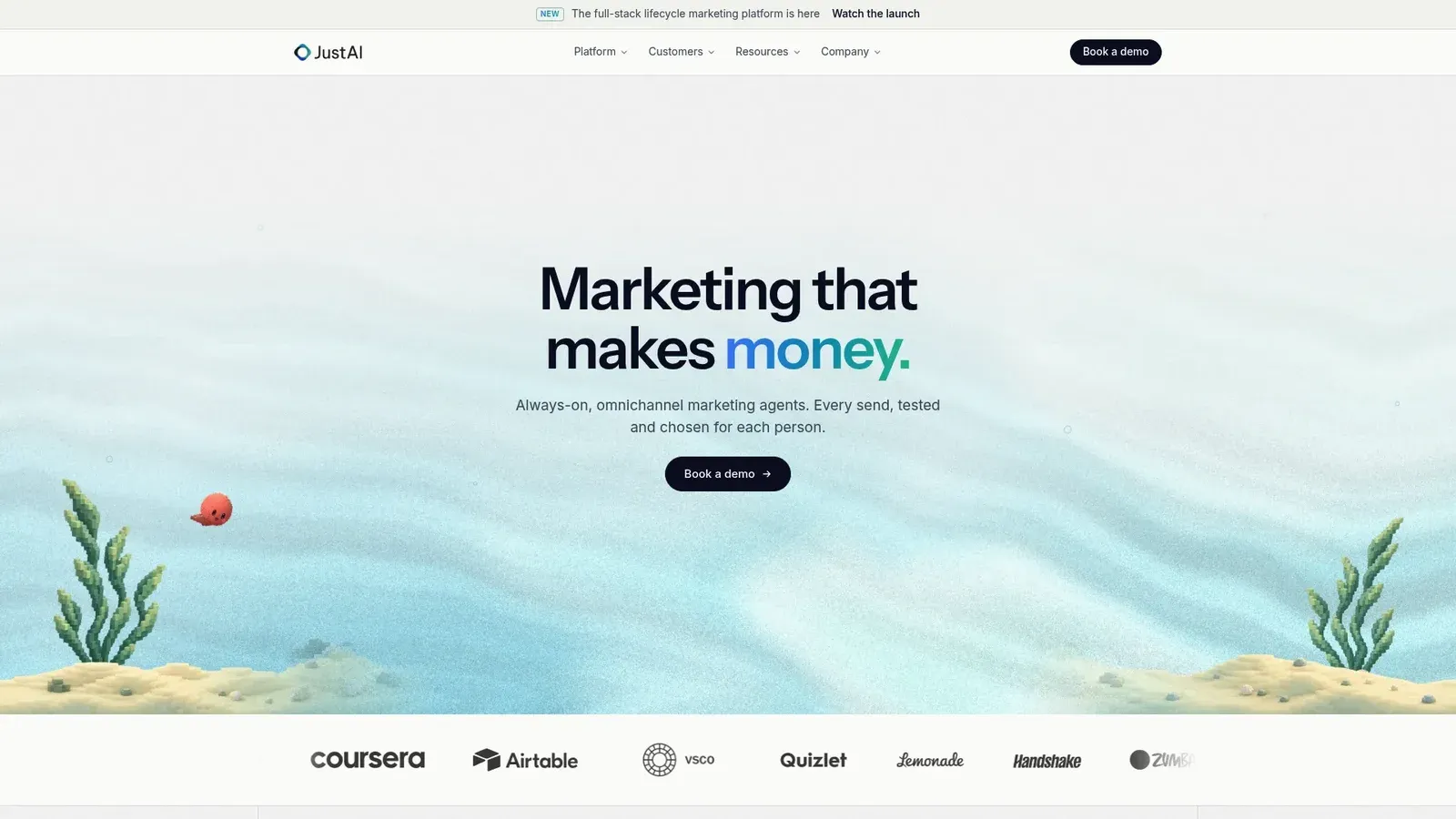
JustAI's home page. Source: JustAI, captured November 2026.
JustAI describes itself as a full-stack AI marketing platform with always-on marketing agents, used by consumer brands such as Coursera and Chime. Its AI drafts on-brand versions of a message for each segment, which the team can edit, and its optimizers send each person one of the versions, rank them against your goal and shift sends toward what works. It connects to Braze, Customer.io, Iterable, Salesforce and Klaviyo, and measures revenue against a holdout.
As with Aampe, the personalization is in the choice: each person receives one of a shared set of versions, where Trophy's AI lifecycle marketing agents write each message for its recipient.
Pros
- Revenue measured against a holdout.
- Works with the sending platform you already have.
Cons
- Versions are shared across many users rather than written for each one.
- Its home page doesn't list a security certification.
Choose JustAI if you want to keep your current sender and add AI that chooses versions for each person. Choose Trophy instead if you want AI lifecycle marketing agents to decide, time and write every message, alongside in-app experiences.
7. Iterable
Best for: enterprise consumer brands that want an independent journey platform close to Braze Pricing: not published; sold through a demo Channels: email, push, web push, SMS, WhatsApp, in-app and embedded messages
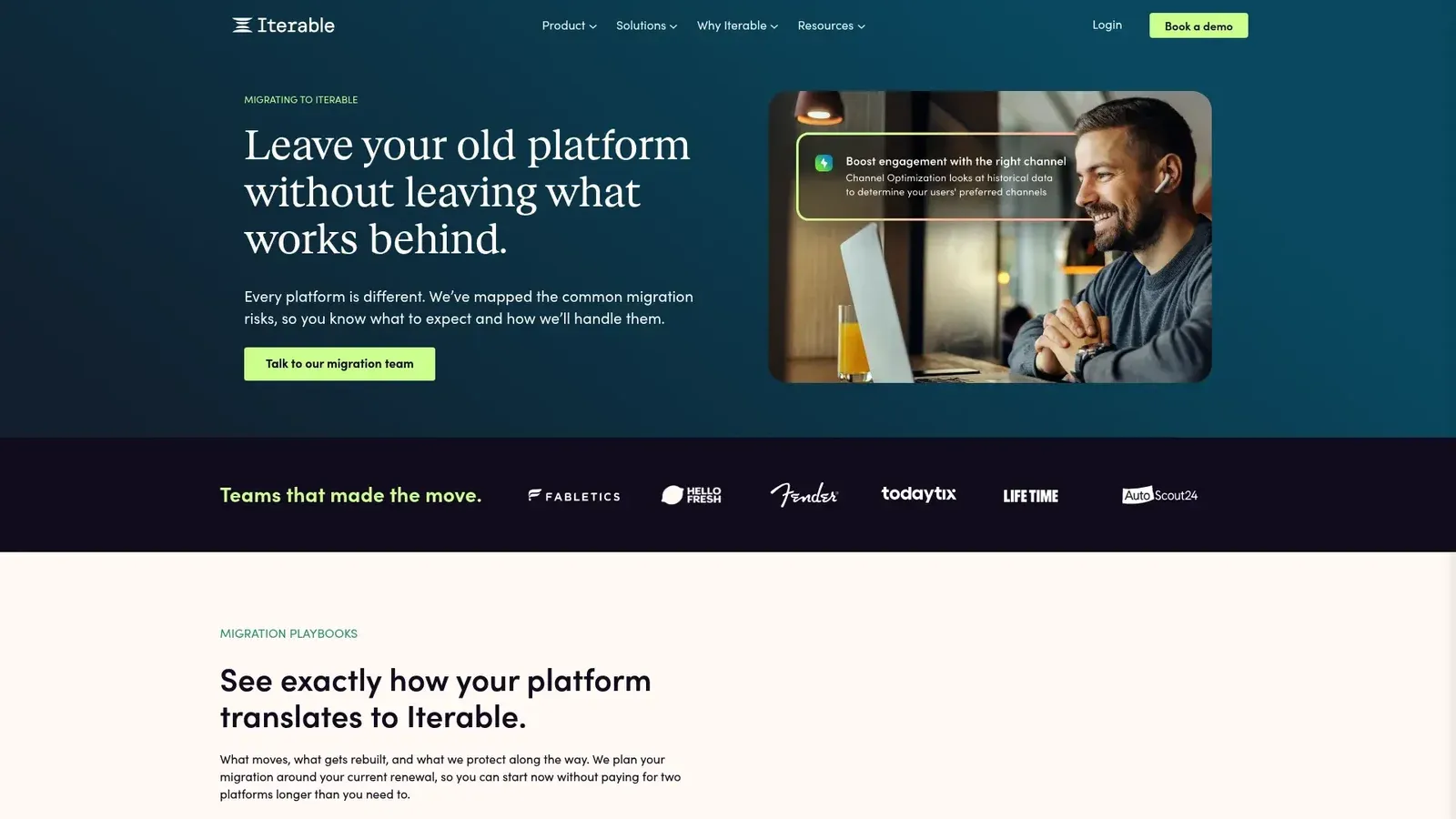
Iterable's migration page. Source: Iterable, captured November 2026.
Iterable calls itself the AI customer engagement platform for enterprise brands, such as Fabletics and HelloFresh. Journeys are its core. Nova agents help teams build audiences, journeys and campaigns faster, and Nova Decisioning picks the next best action within goals and guardrails the team sets. Templates use Handlebars. Its Braze migration plan runs three to nine months for a multi-channel move.
Pros
- The closest like-for-like option to Braze, and independent.
- Lists SOC 2 Type II, ISO 27001 and HIPAA.
Cons
- Templates are Handlebars code.
- Moving from another journey platform is a project of months.
- Its AI helps build journeys rather than replace them.
What reviewers say: 4.3 out of 5 from 63 reviews on Capterra UK.
Choose Iterable if your journeys work and you want an independent enterprise platform. Choose Trophy instead if you'd rather stop rebuilding journeys and let AI lifecycle marketing agents run messaging for each user.
8. Customer.io
Best for: product-led teams that want event-driven messaging with published prices Pricing: Essentials from $100 a month for 5,000 profiles; Premium from $1,000 a month; billed on profiles and email volume. Channels: email, mobile and web push, in-app, SMS, WhatsApp and LINE
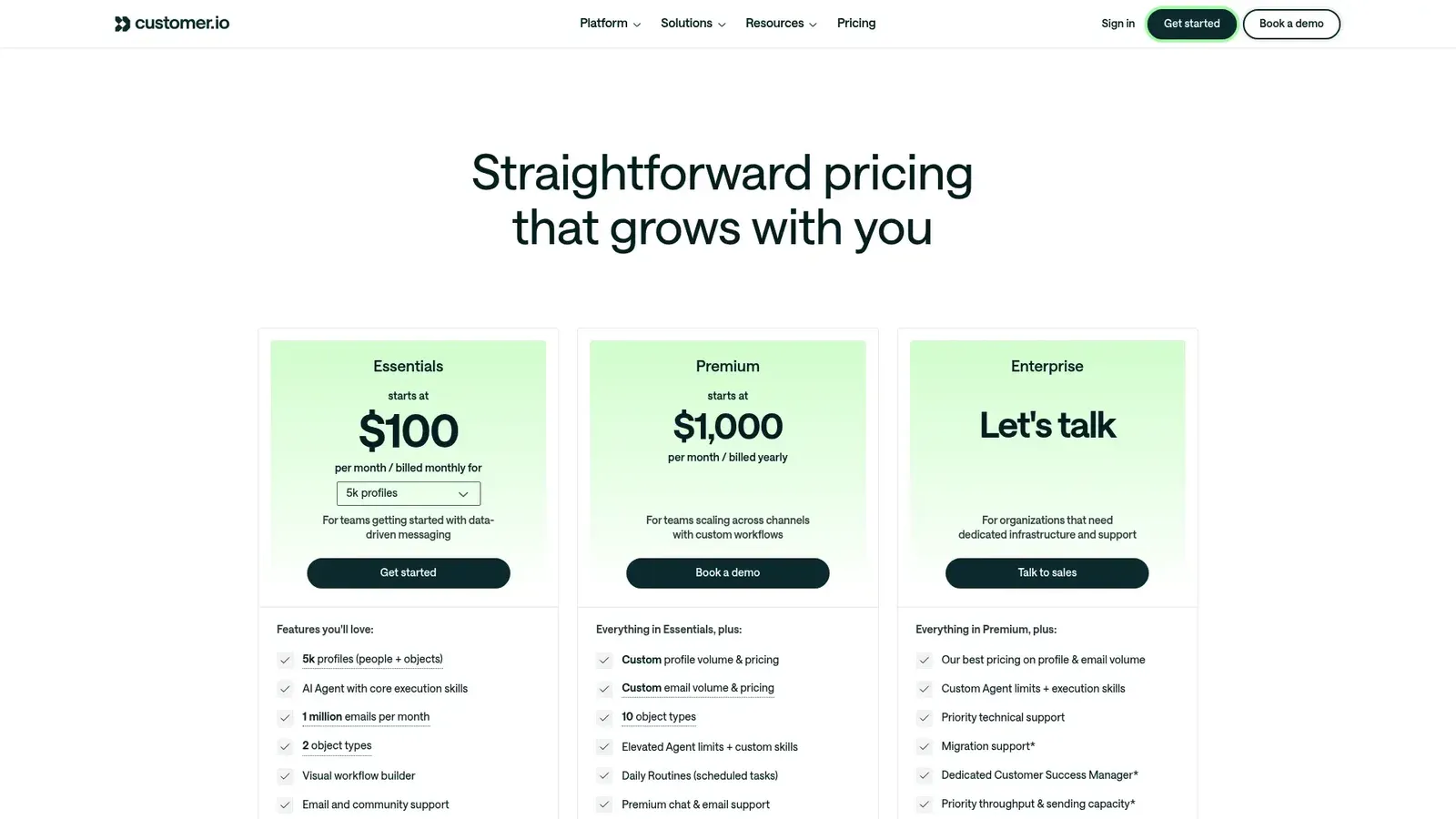
Customer.io's pricing page. Source: Customer.io, captured November 2026.
Customer.io is built around event-driven workflows: triggers, delays and branches that send messages as users act. Its AI Agent (in beta) and LLM actions help teams build and run those workflows rather than replace them. Templates use Liquid, and its docs say a message won't send if Liquid fails to evaluate.
Pros
- Published prices, and unlimited push and in-app messages on every plan.
- Lists SOC 2 Type II and ISO 27001.
Cons
- Templates are Liquid, and a failed template stops the send.
- Its AI assists journey building rather than running messaging.
What reviewers say: 4.6 out of 5 from 106 reviews on Capterra.
A customer lifecycle manager gave Customer.io five stars for its interface and range:
I genuinely enjoy the clean UI and the variety of features on the platform.
Choose Customer.io if your team likes building event-driven workflows. Choose Trophy instead if you're a consumer app that wants AI lifecycle marketing agents to decide and write each message, with no templates that can fail.
9. OneSignal
Best for: push-first teams that want a free start and room to add email, SMS and journeys Pricing: free plan; Growth from $19 a month plus usage for push and email; Professional and Enterprise by quote Channels: mobile and web push, email, SMS and RCS, in-app, Live Activities
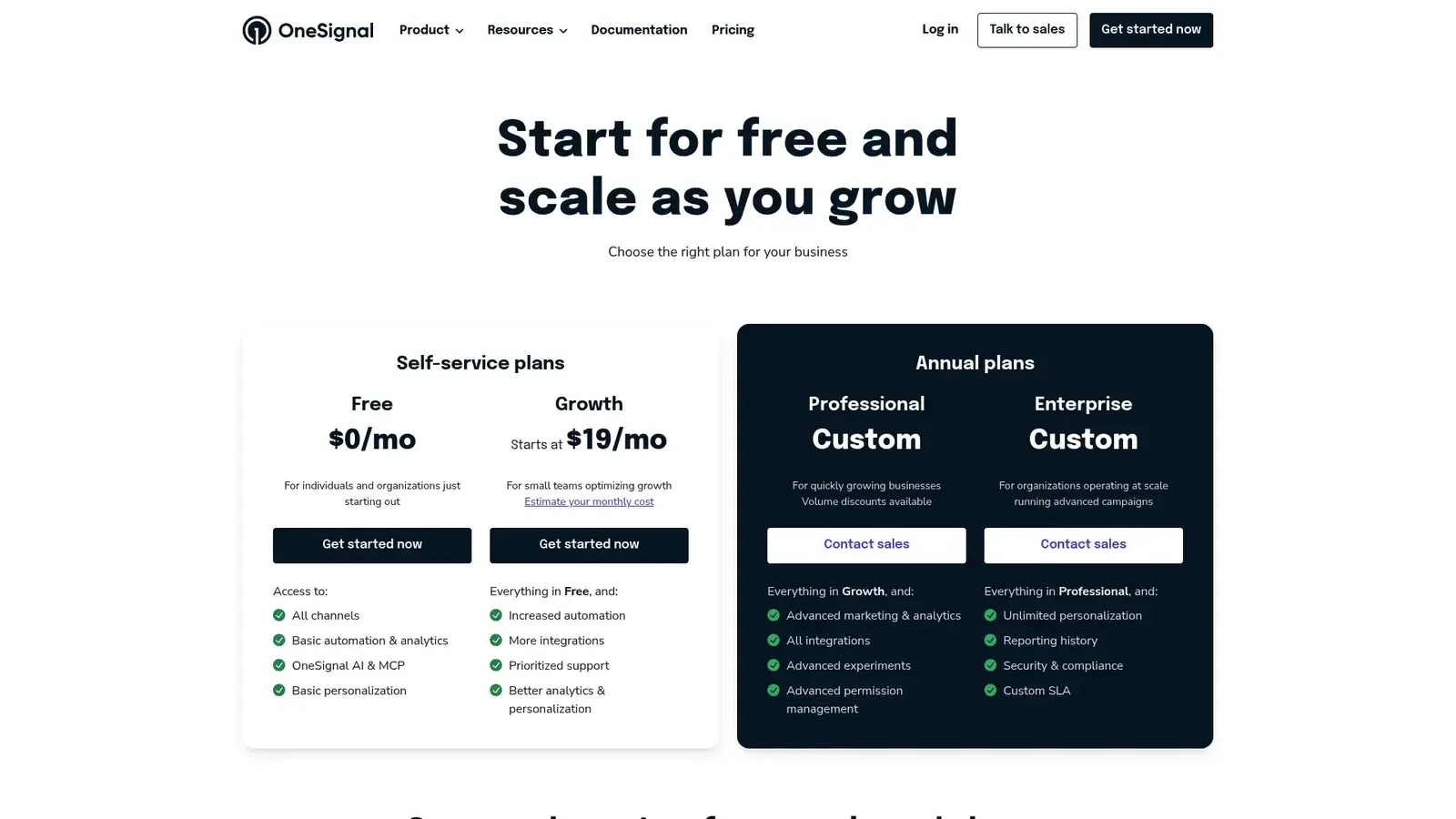
OneSignal's pricing page. Source: OneSignal, captured November 2026.
OneSignal started as push infrastructure and now offers journeys, email, SMS and in-app messages. Active journeys are capped by plan, and Intelligent Delivery handles send timing from Growth up. Templates use Liquid, and its docs note that a missing value renders as an empty string while the message still sends.
Pros
- A free plan and a low paid entry point.
- Push-first, including Live Activities.
Cons
- Templates are Liquid, and gaps can send blank fields.
- Usage pricing grows with push audiences and email volume.
What reviewers say: 4.7 out of 5 from 108 reviews on Capterra UK.
A broadcast media reviewer gave OneSignal five stars for its support:
It's a great computer program with excellent customer service
A software reviewer gave it four stars but warned about cost:
At high volume the pricing climbs quickly…
Choose OneSignal if push is your main channel and you want to start free. Choose Trophy instead if you want AI lifecycle marketing agents to decide when push or email will help each user.
10. Airship
Best for: app-first brands that want push, in-app and mobile wallet with AI that keeps the team in charge Pricing: Airship Experience Platform by quote; Airship Essentials is self-serve Channels: email, SMS, RCS and MMS, push, web notifications, mobile wallet, app and web experiences
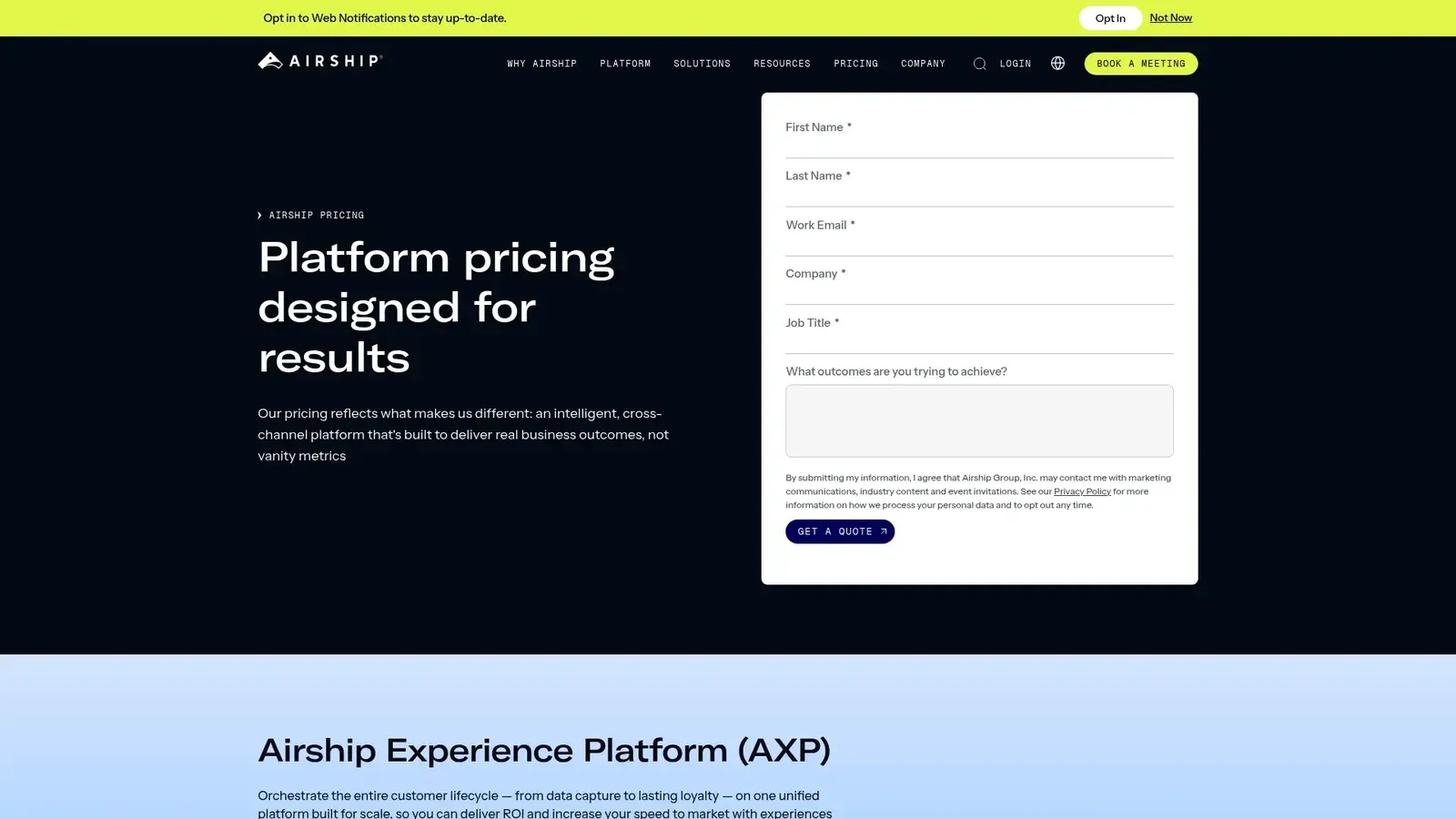
Airship's pricing page. Source: Airship, captured November 2026.
Airship is built for the app: push, in-app experiences, mobile wallet and web notifications, with email and SMS on its Experience Platform. Journeys orchestrate them, and its testing features adjust timing, content and channel. Airship calls its AI human-led and runs a results guarantee program. Templates use Handlebars.
Pros
- Deep app channels, including mobile wallet.
- A self-serve option and a results guarantee program.
Cons
- Templates are Handlebars code.
- Its AI tunes journeys the team builds.
What reviewers say: 4.0 out of 5 from 83 reviews on G2.
Choose Airship if your app is the center of engagement and you want wallet passes alongside push. Choose Trophy instead if you want AI lifecycle marketing agents writing each push and email, with in-app experiences on the same picture of each user.
11. Insider One (for large retail and ecommerce brands)
Best for: enterprise retail and ecommerce brands that want a CDP and many channels in one contract Pricing: not published; a monthly-active-user fee that its own pricing comparison page says includes its AI stack, implementation and support Channels: more than 12 native channels, including email and app and web push
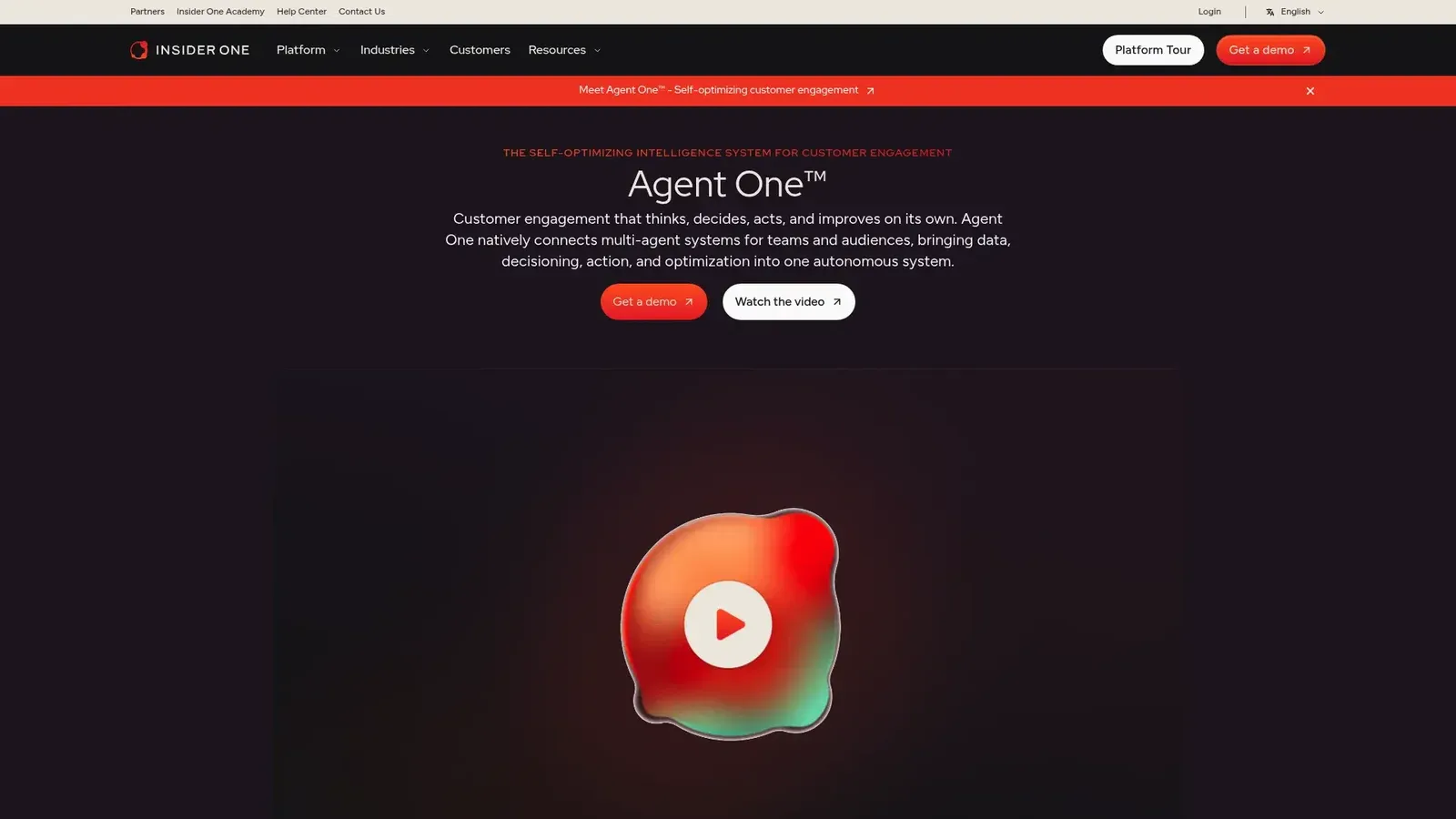
Insider One's Agent One page. Source: Insider One, captured November 2026.
Insider One pairs a native CDP with journeys across more than 12 channels, and acquired Bluecore in May 2026. Agent One launched in September 2026: marketers set objectives and guardrails, and agents plan, create, orchestrate and optimize campaigns. Liquid templates are in early access.
Pros
- AI, implementation, support and a native CDP in one fee.
- Lists SOC 2 Type II and ISO 27001.
Cons
- Built mainly around retail and ecommerce.
- Agents plan and build campaigns rather than writing for each user.
What reviewers say: 4.8 out of 5 from 18 reviews on Capterra UK.
Choose Insider One if you're a large retailer that wants data, channels and services from one vendor. Choose Trophy instead if you're a consumer app that wants AI lifecycle marketing agents and in-app experiences.
12. PostHog Workflows (for PostHog users)
Best for: teams already on PostHog that want simple messaging on the events they track Pricing: the first 10,000 emails free each month, then from $0.003 per email Channels: email, SMS, push and webhooks
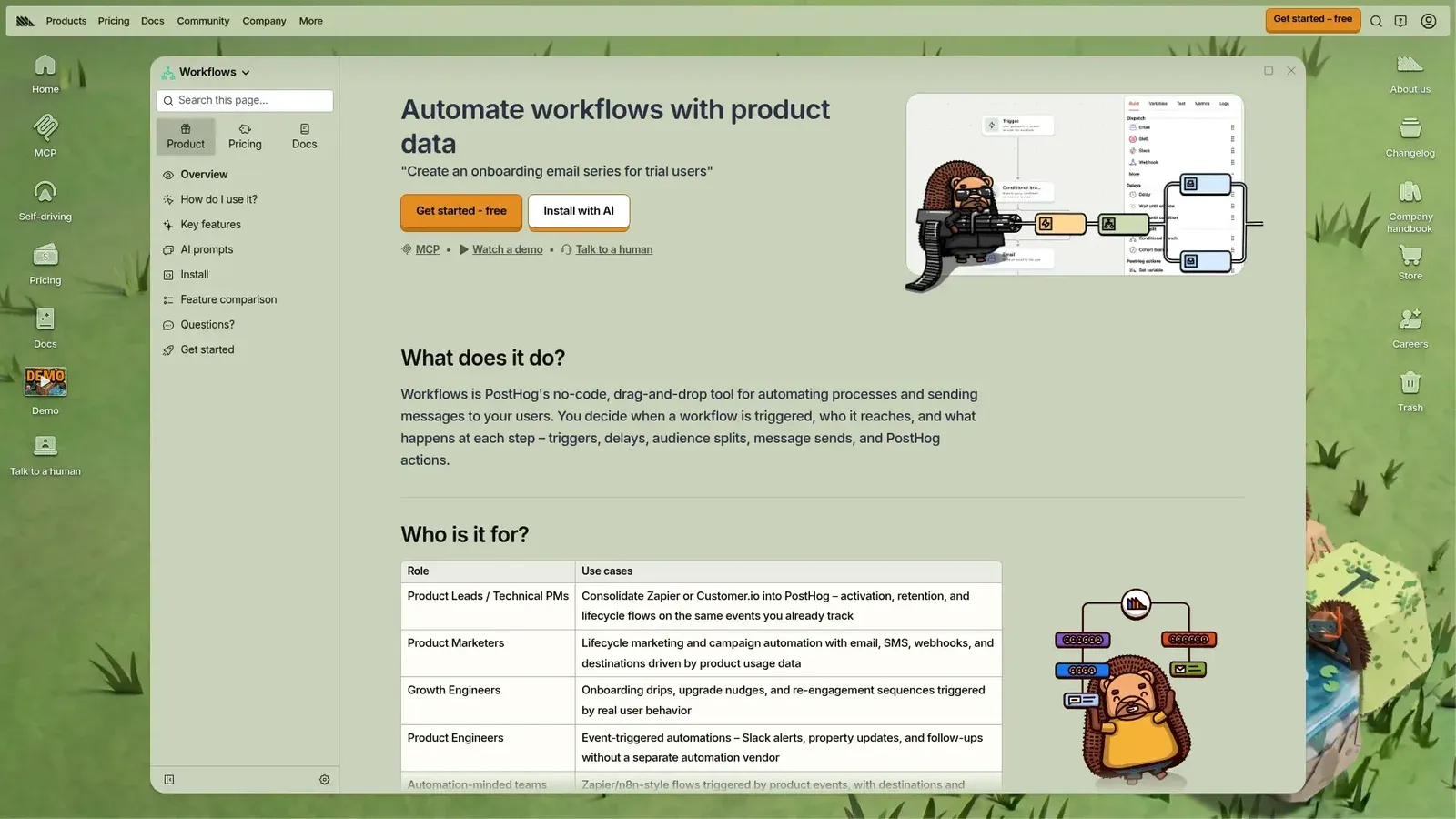
PostHog's Workflows page. Source: PostHog, captured November 2026.
PostHog Workflows is a no-code builder inside PostHog: you choose the trigger, the audience and each step, such as delays, splits and message sends, using events PostHog already tracks. PostHog AI can generate email templates and set up multi-step workflows, but the workflows themselves are rules. Templates use Liquid, and an email whose Liquid doesn't compile isn't sent. It's the realistic baseline for teams starting with their analytics tool.
Pros
- No new data pipeline, and low per-email pricing.
- Lists SOC 2 Type II.
Cons
- Rule-based workflows, with no per-user decisioning.
- Its Workflows page doesn't describe a holdout.
Choose PostHog Workflows if you're on PostHog and want basic messaging on events you already track. Choose Trophy instead if you want AI lifecycle marketing agents deciding, timing and writing each message, measured against a holdout.
How to choose
The deciding factors are whether you want your team to build and maintain journeys or AI to run lifecycle messaging for each user, and whether the platform is focused on consumer apps. Then match the need:
- Trophy if you're a consumer app and want AI lifecycle marketing agents working for each user individually that deliver the right messages at the right time, measured against a holdout.
- Sequenzy if you're a small team that wants email, push and in-app messages in one affordable, AI-native tool.
- Braze or Iterable if a dedicated CRM team runs large journey programs: Braze for the longest channel list, Iterable for an independent platform.
- CleverTap if you want analytics and engagement in one mobile-first tool.
- MoEngage or JustAI if you want AI to choose among versions your team prepares.
- OneSignal or PostHog Workflows for a free or low-cost start on push or email.
Other names you'll see: Klaviyo and Bloomreach are built mainly for ecommerce, Salesforce Marketing Cloud serves enterprise marketing teams, and Firebase Cloud Messaging is push infrastructure that platforms send through.
Book a demo to test Trophy's AI lifecycle marketing agents against your current setup on a share of your users.
FAQ
What is the best customer engagement platform for a consumer app?
It depends on how you want messages decided. Trophy is focused on consumer apps, with AI lifecycle marketing agents trained on consumer app behavior that decide, time and write every message; Braze suits enterprise CRM teams, Sequenzy small budgets and CleverTap teams that want analytics built in.
What is customer engagement software?
Customer engagement software decides which messages each customer receives, on which channel and when: email, push, in-app messages and sometimes SMS. The term also covers support desks, live chat and sales tools; for consumer apps, what matters is acting on in-app behavior to bring users back.
What makes a customer engagement platform's cost grow?
Usually the users it counts (monthly active, tracked or stored profiles), message volume, and add-ons such as AI decisioning, extra channels or AI credits. Trophy never bills for lapsed or inactive users, and pricing for its plans is provided as part of a demo.
Do I still need journeys?
Not with every platform. In a journey builder, each new scenario means another branch or template. Trophy replaces journeys with AI lifecycle marketing agents that work toward objectives you set, inside your brand kit and sending limits.
How do I know if a platform's AI is working?
Ask how uplift is measured. Opens and clicks don't show whether a message changed behavior; a holdout group that receives no messages gives a clean comparison on retention and other KPIs. Trophy measures against a holdout that never receives messages from the AI lifecycle marketing agents.
How much engineering does a customer engagement platform need?
Most platforms need your app to send events and user attributes, plus SDK work for push and in-app messages. With Trophy, your engineers send the events you already track, once, and Trophy builds the integrations with you. After that, marketing runs it.
Find out if Trophy beats your current setup
If your messages still come from journeys and templates someone has to maintain, the real question is whether AI can run lifecycle messaging for each user better than your current program. A holdout will show you.
Book a demo to test Trophy's AI lifecycle marketing agents against your current setup on a share of your users.