Quick answer
Braze is a powerful cross-channel platform for large consumer brands with a CRM team to run it. Teams look elsewhere when a renewal lands mid-acquisition, when journeys and Liquid templates need more people than they have, when they want AI that does more than build campaigns, or when pricing has too many moving parts.
| Tool | Best for |
|---|---|
| Trophy | AI lifecycle marketing agents for every user instead of journeys |
| Iterable | A like-for-like journey platform and a planned migration off Braze |
| OneSignal | Push-first apps that want a free plan and pay-as-you-grow pricing |
Book a demo to see if Trophy's AI lifecycle marketing agents can outperform your current customer engagement platform.
Why trust us
We build Trophy, the 1:1 customer engagement platform for consumer web and mobile apps, so we spend every day on the problem Braze customers are trying to solve: getting users to come back. Trophy's customers include consumer apps such as RevisionDojo, Campfire, Lexioo, Bohemian Research, CyberPatient, Leal and Ritmo, from RevisionDojo's 350,000 students to the more than a million authors writing on Campfire.
Our in-app experiences lifted 14-day retention by 22% at Campfire and 9% at RevisionDojo. That work led us to build AI lifecycle marketing agents, and it's why we know these tools well: they're the platforms the growth teams we work with are using, replacing or weighing up.
We've put Trophy first because we think it's the best fit for many consumer apps, and we say plainly where another tool fits better. Leal, a loyalty platform used by large retailers across Latin America, measured Trophy's in-app experiences against a control group:
Trophy helped us put [in-app experiences] in front of our merchants without building [the engine behind them] ourselves. In our first pilot in Panama, the dynamics lifted redemption rate by 22% against the control group.
 Emiliano AristizábalHead of Product, Leal
What is Braze?
Braze is a cross-channel customer engagement platform built for large consumer brands. Teams use it to send email, push, SMS, WhatsApp and in-app messages from one place, organize them into journeys called Canvases, and use its BrazeAI suite to build campaigns faster and personalize what each customer sees. Its customers lean toward big retail, media, finance and travel brands with a dedicated CRM team.
Its core features include:
- Canvas journeys with branching, experiments and frequency caps.
- Wide channel coverage, including RCS, LINE and KakaoTalk alongside email, push and SMS.
- BrazeAI Operator, an assistant that builds content, campaigns and Canvases from a prompt.
- BrazeAI Decisioning Studio, which chooses offers, timing and channels for each customer.
- Content Cards and in-app messages for experiences inside your app.
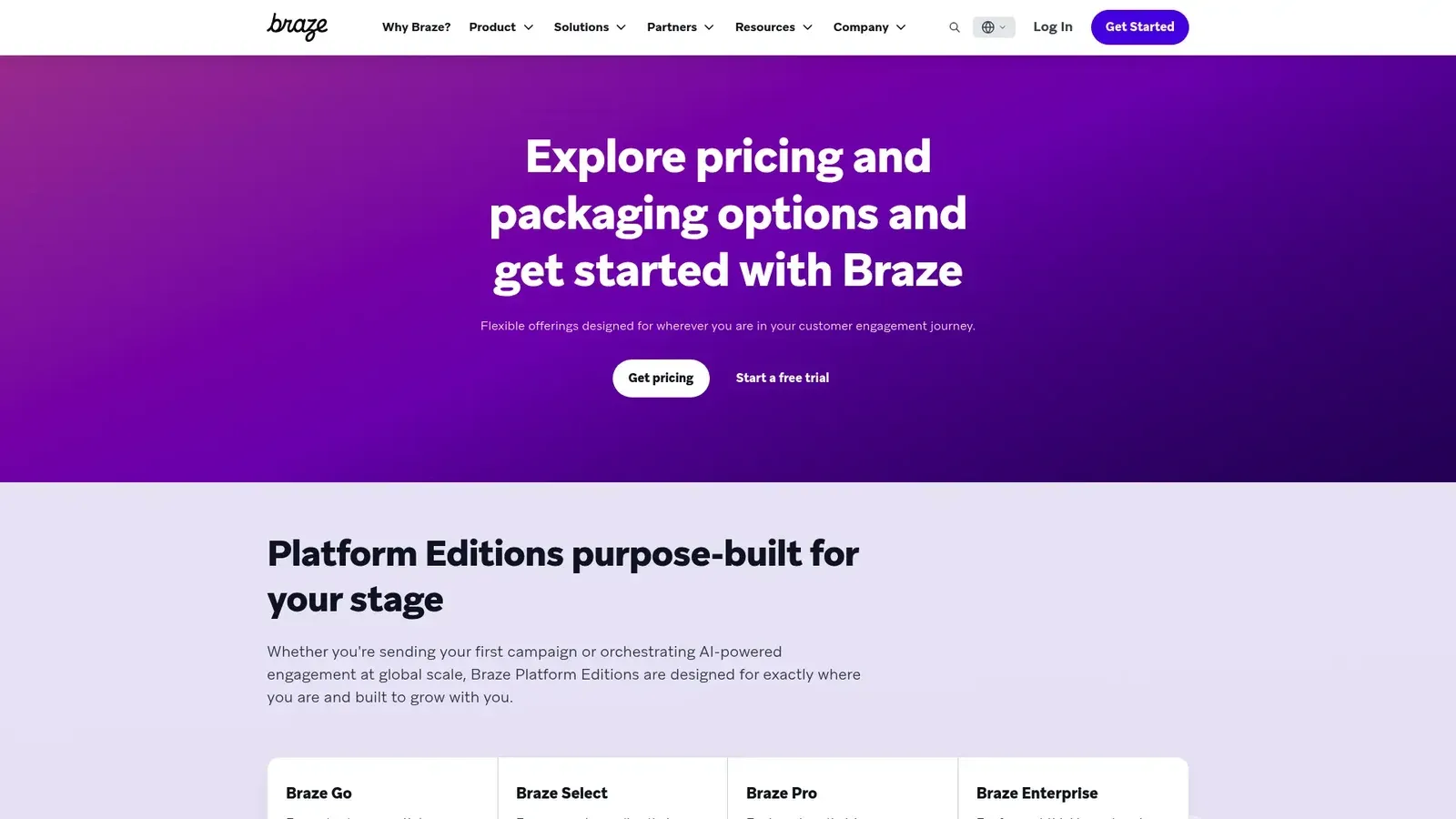
Braze sells four platform editions through its sales team. Source: Braze, captured November 2026.
Braze rates 4.7 out of 5 from 168 reviews on Capterra UK.
Why teams look for Braze alternatives
1. The Salesforce acquisition
On 20 October 2026, Salesforce agreed to acquire Braze for about $5.66 billion, with closing expected in Salesforce's 2028 financial year. Salesforce's announcement says Braze will strengthen Marketing Cloud and work across Data 360, Customer 360 and Agentforce. Braze says it will keep building as Braze, but teams renewing before the deal closes are weighing how long to commit.
2. Support and a say in the roadmap
The support you get from Braze depends on the service plan you buy, with round-the-clock support aimed at its largest customers, and product priorities are set across thousands of brands, soon alongside Salesforce's plans. Many consumer apps would rather work directly with the people who build their platform and have a real say in what gets built next.
3. Journeys to build and maintain
Braze runs on Canvases your team designs. BrazeAI Operator can draft one from a prompt, but someone still owns every branch, template and test once it's live, and onboarding, engagement and win-back journeys add up quickly. A food and beverage reviewer on Capterra UK gave Braze five stars for its breadth of automation and personalization across channels, but said the learning curve can be a lot for a lean team:
Due to all the functionality there is a bit of a learning curve…
4. Personalization written in Liquid
Braze personalizes messages with Liquid, the template language Shopify created, and supports only some of Shopify's Liquid, so even people who know it have Braze's version to learn. Inserting a first name takes a click, but anything conditional, such as different copy for different users, a fallback or a formatted date, is code your team writes with tags and filters. A short streak reminder looks like this:
Hey {{${first_name} | default: 'there'}},
{% if {{custom_attribute.${streak_days}}} >= 7 %}
You're on a {{custom_attribute.${streak_days}}}-day streak. Keep it going today.
{% else %}
Pick up where you left off.
{% endif %}
Someone has to write or review that for every template and every variant, test it against real profiles, and keep it working as your data changes. Braze's own guide to conditional logic has tips for when you're having a hard time, and Braze has built an AI Liquid Assistant, in beta for some customers, to write it for you. A campaign manager at a small business who rates Braze 2 out of 5, and likes its AI execution and smarter frequency capping, called Liquid the biggest issue:
…it still relies on manual Liquid code for routine dynamic personalization.
Almost every alternative below works the same way, in Liquid or another template language. The comparison table shows which. Trophy has no templates to write; see how Trophy and Braze decide what to send for the difference.
5. Wanting AI that does more than build sequences
Braze's AI mostly speeds up the existing way of working: Operator builds Canvases faster, and Decisioning Studio chooses between the messages and offers your team writes. Some teams want AI to go further: to decide for each user whether anything is worth sending, pick the channel and the best timing, and write the message itself. That's the difference between an AI sequence builder and a 1:1 system.
Journey builders also look more flexible than they are. Every branch, filter and template is a rule someone set up, so anything the builder wasn't designed for turns into a workaround: another branch, more template code or a second tool. An AI system reasons about each user instead of following fixed paths, so a new requirement is something you tell it, much as you'd brief someone on your team.
6. Pricing with many moving parts
A Braze contract is built from several separately priced parts: a platform edition, monthly active users and profiles, a pool of Action Credits, add-ons across its data platform and BrazeAI, and services. That makes the bill hard to forecast before you talk to sales, and the credit pool, which email, SMS, WhatsApp and AI features such as Agent Console all draw on, gets used faster as you send more or lean harder on AI. Our Braze pricing breakdown explains each part and what makes the bill grow. A financial services reviewer on Capterra UK gave Braze five stars as an easy, all-in-one option for brands with both a website and an app, then added a caveat on cost:
…but adding more emails is pricey.
10 Braze alternatives compared
| Tool | Best for | How it decides what to send | Templates written in | How uplift is measured | Pricing basis | Security |
|---|---|---|---|---|---|---|
| Trophy | 1:1 messaging without journeys | An AI lifecycle marketing agent per user | No templates to write | Holdout group | Provided as part of a demo | SOC 2 Type II, ISO 27001 |
| MoEngage | AI decisioning in a full suite | Journeys plus AI that picks a variant per user | Jinja | Global control groups | Tracked users; quote | ISO 27001, ISO 27701, AICPA SOC |
| Iterable | A like-for-like move | Journeys plus Nova decisioning | Handlebars | Not described on pages checked | Quote | SOC 2 Type II, ISO 27001, HIPAA |
| Insider One | Enterprise retail and commerce | Journeys plus Agent One agents | Liquid (early access) | Not described on pages checked | Quote | SOC 2 Type II, ISO 27001 |
| CleverTap | Mobile analytics plus engagement | Journeys; decisioning agents on Ultimate | Liquid | Control groups | MAU or data points; from $85 a month | SOC 2 Type II, ISO 27001 |
| Airship | App-first experiences | Journeys with automatic optimization | Handlebars | Not described on pages checked | Quote; self-serve Essentials | SOC 2 |
| OneSignal | Push-first apps on a budget | Journeys and segments you build | Liquid | A/B tests | Free plan; Growth from $19 a month plus usage | GDPR with DPA |
| Customer.io | Published prices and a workflow builder | Workflows with AI steps | Liquid | A/B tests | Profiles and emails; from $100 a month | SOC 2 Type II, ISO 27001 |
| Hightouch (works alongside Braze) | Decisioning on warehouse data | AI agents that send through your existing platform | Your sending platform's language | Not described on pages checked | Usage-based; quote | SOC 2 Type II, ISO 27001 |
| PostHog Workflows (for PostHog users) | Simple flows inside PostHog | Rules from events and cohorts | Liquid | No holdout described | Per email; 10,000 free a month | SOC 2 Type II |
Checked on each vendor's site on 25 November 2026; confirm details with the vendor.
The 10 best Braze alternatives for consumer apps
1. Trophy
Best for: consumer web and mobile apps that want AI lifecycle marketing agents working for every user instead of journeys Pricing: provided as part of a demo Channels: email from your own domain, push through your FCM, APNs or Expo setup, and in-app experiences
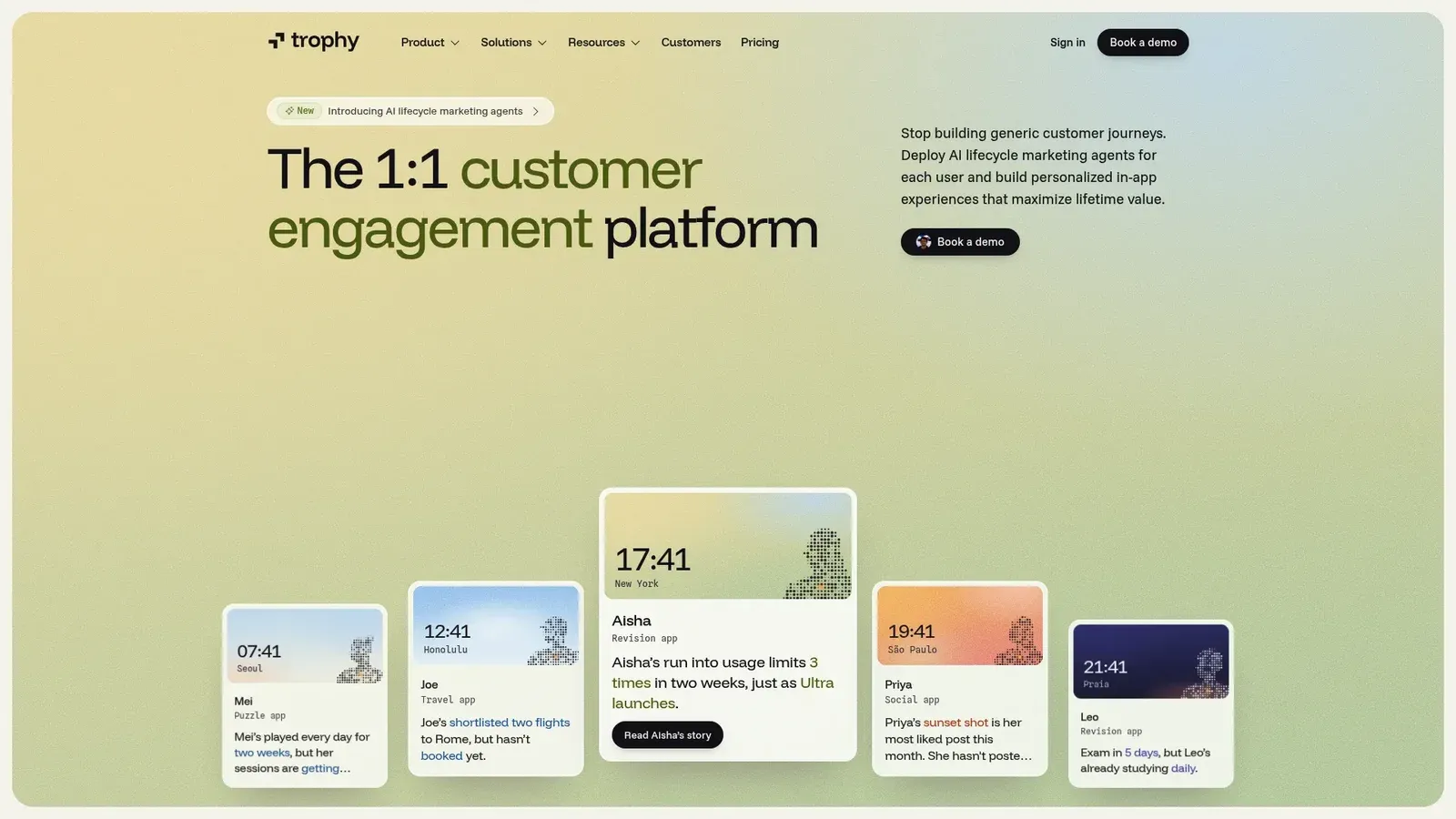
Trophy's home page. Source: Trophy, captured November 2026.
Trophy is the 1:1 customer engagement platform for consumer web and mobile apps. Instead of journeys, it gives each user their own AI lifecycle marketing agent, which reads that user's in-app activity, decides whether a message is worth sending, picks email or push and the best timing, and writes it. In-app experiences such as streaks, milestones and leaderboards read the same picture of each user, so every message reflects what that person actually did.
Key features
- Objectives instead of journeys: set an objective such as activation, engagement, conversion or retention, and weight the outcomes that matter most.
- Your brand kit instead of templates: AI lifecycle marketing agents write every subject line, email and push in your voice, from your style guidelines, your images tagged by tone and use case, and the topics and phrases never to use. There's no Liquid to write or review. Lifecycle emails send from your domain and push notifications through your own provider, within weekly and monthly caps per user.
- A holdout from day one: a share of users never receives messages from the AI lifecycle marketing agents, so you see uplift in retention and your other KPIs rather than in opens.
- The team that builds it: a shared Slack channel with the people who build Trophy, integrations built with you, and weekly KPI reporting.
Where Trophy beats Braze: there are no Canvases, templates or Liquid to maintain, because each AI lifecycle marketing agent decides, times and writes every message for its user, and you work directly with the people building the product. Pricing is simpler too: three plans, with AI lifecycle marketing agents, email, push and every in-app experience included on all of them rather than sold as add-ons. Business adds SSO, MFA and role-based access, Enterprise adds multi-tenancy, data residency and a custom SLA (compare plans), and Trophy is SOC 2 Type II and ISO 27001 certified. We compare the two in depth in Trophy vs Braze.
What reviewers say: Trophy rates 4.8 out of 5 from 7 reviews on G2.
Is Trophy right for your team?
- Built for 1:1 by design: teams that want to hand-build every flow will be happier with Iterable or Braze.
- Email, push and in-app: if SMS or WhatsApp carries your program, look at MoEngage or Customer.io.
- A little engineering, once: your engineers send the events you already track; marketing runs everything after that, with no template code to write.
- Start with a pilot: on a small share of your users against a holdout, so you see the uplift before rolling out.
See how Trophy works for marketing teams, or book a demo.
2. MoEngage
Best for: consumer apps that want AI decisioning inside a full suite of journeys and analytics Pricing: billed on monthly tracked users across Growth and Enterprise plans, by quote Channels: mobile and web push, email, SMS, in-app and on-site messages, with WhatsApp and RCS as add-ons
MoEngage sells its plans by quote. Source: MoEngage, captured November 2026.
MoEngage is a full customer engagement suite popular with consumer apps, and since it acquired Aampe in June 2026 it markets an AI agent behind every customer. In practice the AI sits on top of its journey tools: your team still builds the templates and message variations, writing any logic in Jinja, often through an approval workflow, and the AI chooses between them for each user. That's a real step beyond A/B tests, but it isn't an agent writing each message from scratch.
Key features
- Campaign Decisioning (add-on): you create several full versions of a message and it picks one per user toward your goal.
- Global control groups: hold all messaging back from a random set of users to measure uplift.
Where MoEngage beats Braze: AI decisioning sits next to journeys and analytics in one suite, billed on tracked users rather than message credits.
Where MoEngage falls short: agents and decisioning are add-ons on both plans, and your team still produces and reviews the variations the AI chooses between. MoEngage recommends a basic understanding of Jinja for advanced personalization and offers an AI assistant for teams with limited Jinja skills.
What reviewers say: MoEngage rates 4.3 out of 5 from 58 reviews on Capterra UK. An IT services reviewer who gave it 3 out of 5 was critical of segmentation speed and delivery:
…creating segments are relatively slow and the delivery rate is poor.
Choose MoEngage if you want journeys, analytics and AI variant selection in one suite. Choose Trophy instead if you want AI lifecycle marketing agents writing and timing every message, with no templates to maintain.
3. Iterable
Best for: teams that want to keep a journey-led program and move off Braze with a planned migration Pricing: not published; sold through a demo Channels: email, push, SMS and in-app
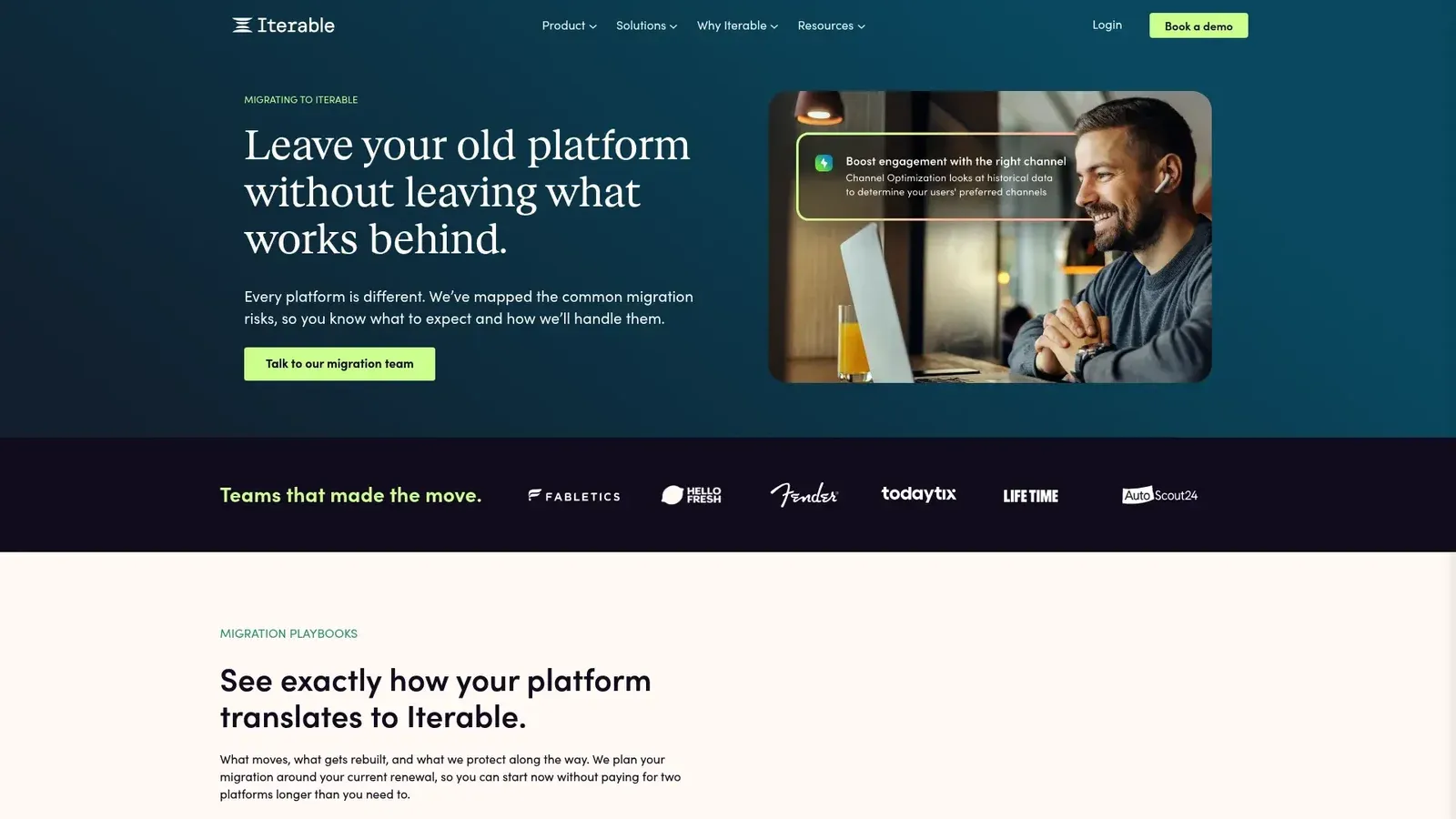
Iterable publishes migration playbooks for teams leaving Braze. Source: Iterable, captured November 2026.
Iterable is the closest like-for-like alternative to Braze: an enterprise platform built around journeys, with its Nova AI layer helping build campaigns and pick the next best action. It's also the best prepared for Braze customers, with a migration playbook that rebuilds Canvases as Journeys, translates Liquid templates into Handlebars, Iterable's template language, protects push tokens and plans the switch around your renewal date, typically over three to nine months for a multi-channel move.
Where Iterable beats Braze: it sits outside the Salesforce deal and keeps the journey model your team already knows.
Where Iterable falls short: journeys and templates move with you rather than going away, with your Liquid rewritten in Handlebars, and Iterable estimates 45 to 60 engineering hours per brand.
What reviewers say: Iterable rates 4.3 out of 5 from 63 reviews on Capterra UK. A banking reviewer gave it five stars for its event charts and tables for targeting emails, while noting that very high message volumes can overwhelm the API:
Nice tool that has an interface really ease to use.
An automotive reviewer who gave it 3 out of 5 praised its flexibility and quick onboarding, but was frustrated by slow support, unexplained SMS blocking and an extra fee for creating senders:
Good product, poor aftersales experience.
Choose Iterable if your Canvases work well and you want an independent home for them. Choose Trophy instead if you'd rather stop maintaining journeys and let AI lifecycle marketing agents decide what each user receives.
4. Insider One
Best for: large retail and commerce brands that want a CDP, journeys and AI agents in one enterprise suite Pricing: not published; sold through a demo Channels: more than 12, spanning messaging and web and app personalization
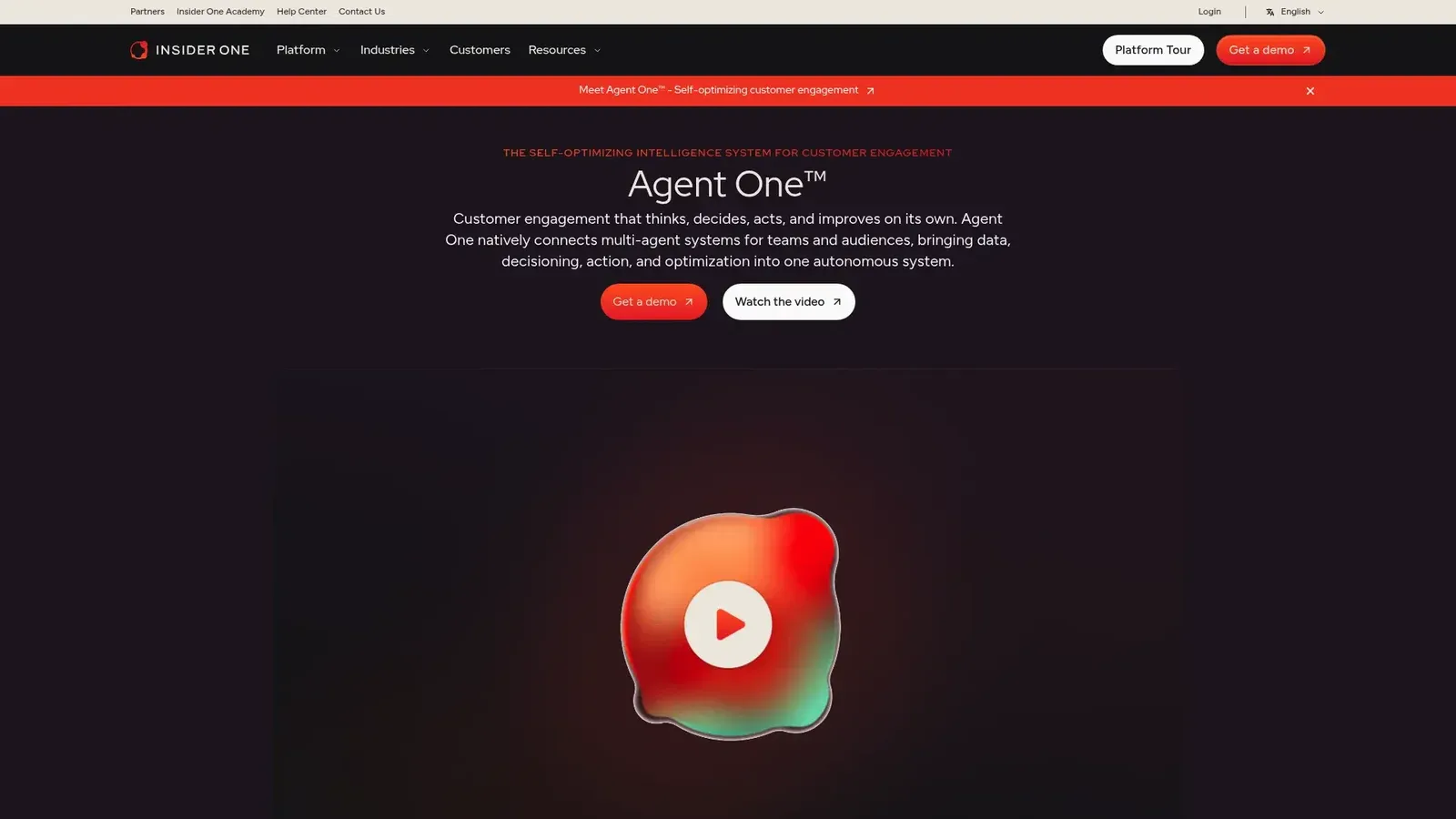
Insider One's Agent One page. Source: Insider One, captured November 2026.
Insider One positions itself as an agentic customer engagement platform. In September 2026 it launched Agent One, a set of AI agents for audiences and team workflows, and in May it acquired retail platform Bluecore, deepening its focus on large retailers.
Where Insider One beats Braze: a built-in CDP and on-site personalization in the same contract.
Where Insider One falls short: it leans toward enterprise retail, which can be more platform than a consumer app needs, and personalization logic is written in Liquid, still in early access for email, push and web templates.
What reviewers say: Insider One rates 4.8 out of 5 from 18 reviews on Capterra UK. A retail reviewer gave it five stars for its features and responsive team, though they'd like more web and app templates:
We are very satisfied with what Insider One provides overall.
An information services reviewer who rated it 4 out of 5 found it easy to manage messages in one place, but some tools limited and hard to navigate:
…some features could be more intuitive.
Choose Insider One if you're a large commerce brand consolidating data, personalization and messaging. Choose Trophy instead if you're a consumer app that wants AI lifecycle marketing agents without an enterprise suite to run.
5. CleverTap
Best for: mobile-first apps that want product analytics and engagement in one tool, with a self-serve plan Pricing: based on monthly active users or data points; Core lists $85 a month for up to 5,000 MAU with a free trial, and Pro and Ultimate are sold through a demo Channels: push, in-app, app inbox and web, with email, SMS, WhatsApp and RCS as add-ons
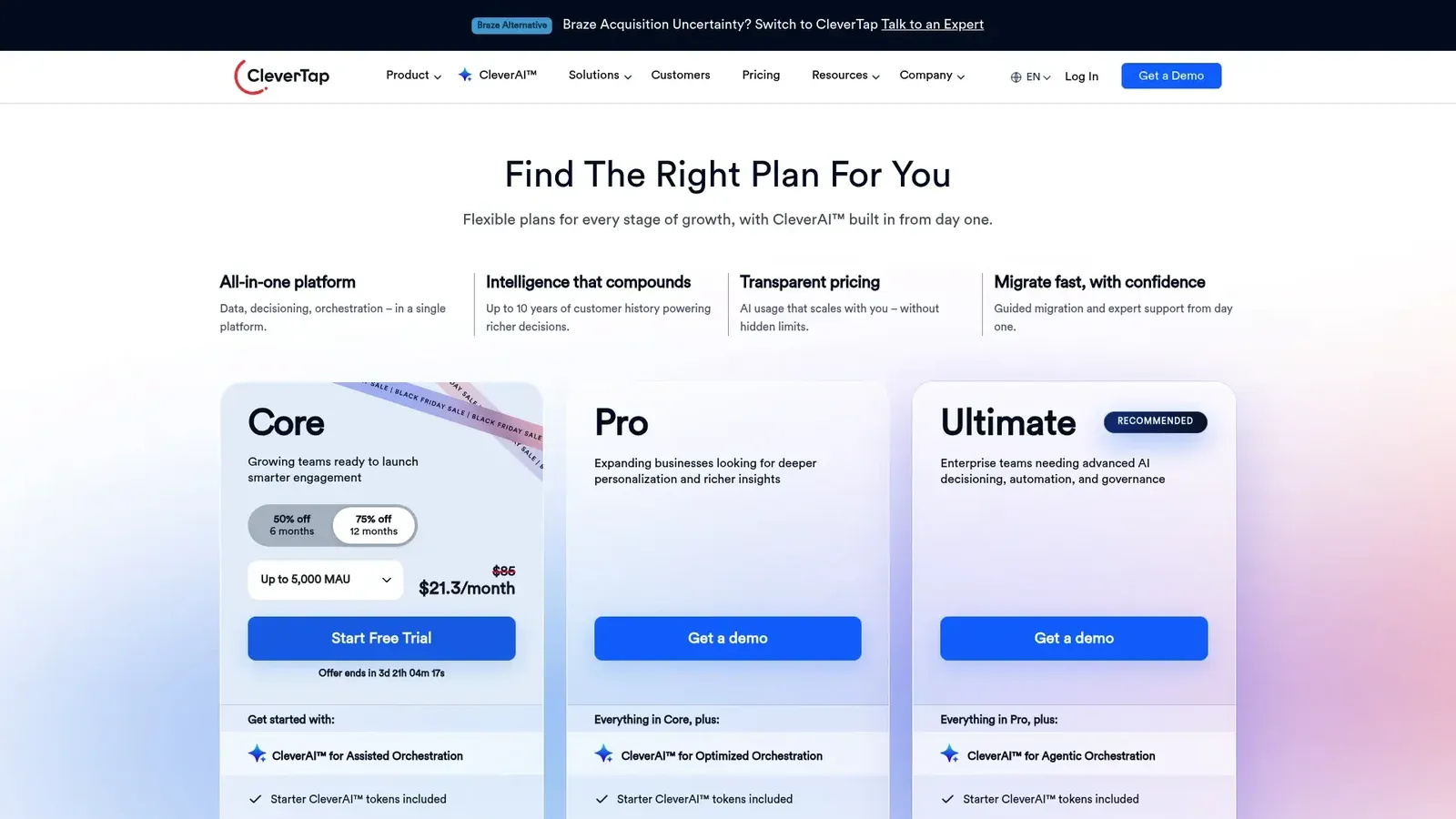
CleverTap's pricing page, which currently runs a banner aimed at Braze customers. Source: CleverTap, captured November 2026.
CleverTap combines mobile analytics such as funnels and cohorts with messaging, and includes control groups on every plan, which suits product-led teams that want to see behavior and act on it in one place. It's actively courting Braze customers, and its top plan adds decisioning agents that choose between campaigns, variants and lifecycle paths.
Where CleverTap beats Braze: a published entry price, a free trial and product analytics in the same tool.
Where CleverTap falls short: email is an add-on on every plan, decisioning agents are an Ultimate add-on, and conditional personalization is written with Liquid tags in each message.
What reviewers say: CleverTap rates 4.4 out of 5 from 68 reviews on Capterra UK. A games company reviewer who gave it five stars after switching from another tool wrote:
CleverTap has so much functionality, I especially like the ease of use of journeys…
An education reviewer who also gave five stars, and found segmentation across SMS, WhatsApp and push easy, flagged one concern:
The push notification delivery rates in CleverTap are somewhat low for Android devices…
Choose CleverTap if you want push-first engagement and analytics together. Choose Trophy instead if email matters as much as push and you want AI lifecycle marketing agents deciding the right message for each user.
6. Airship
Best for: app-first brands where push, in-app and mobile experiences are the main channel Pricing: the Airship Experience Platform is sold by quote, and Airship Essentials is a self-serve plan for app and web experiences Channels: push, in-app, web notifications, email, SMS and RCS, and mobile wallet
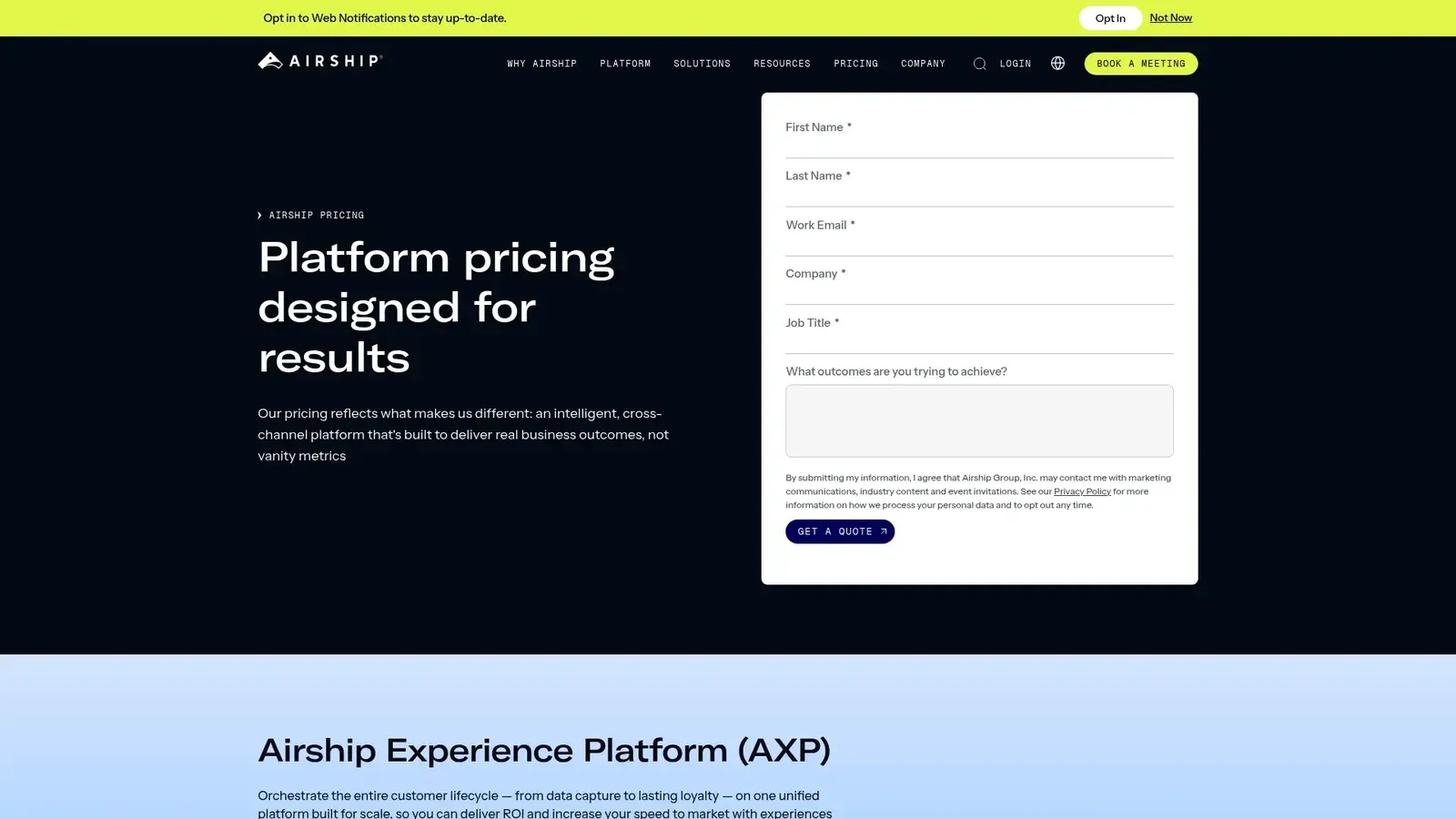
Airship sells its full platform by quote. Source: Airship, captured November 2026.
Airship started as a push provider and is strongest inside the app: rich push, in-app experiences, mobile wallet passes and Live Activities. Its AI is designed to keep marketers in control of what goes out, and it offers a results guarantee on its full platform.
Where Airship beats Braze: depth inside the app, and a self-serve way to start with Essentials.
Where Airship falls short: the full cross-channel setup, including email, needs the quoted platform rather than Essentials, and personalization is written in Handlebars.
What reviewers say: Airship rates 4.0 out of 5 from 83 reviews on G2.
Choose Airship if your app is the main place you engage customers. Choose Trophy instead if you want AI lifecycle marketing agents deciding when each user should hear from you, across email and push.
7. OneSignal
Best for: push-first apps that want a free plan and pay-as-you-grow pricing Pricing: free plan; Growth from $19 a month plus usage (mobile push at $0.012 per monthly active user); annual Professional and Enterprise plans by quote Channels: mobile and web push, in-app, email, SMS and RCS, and Live Activities
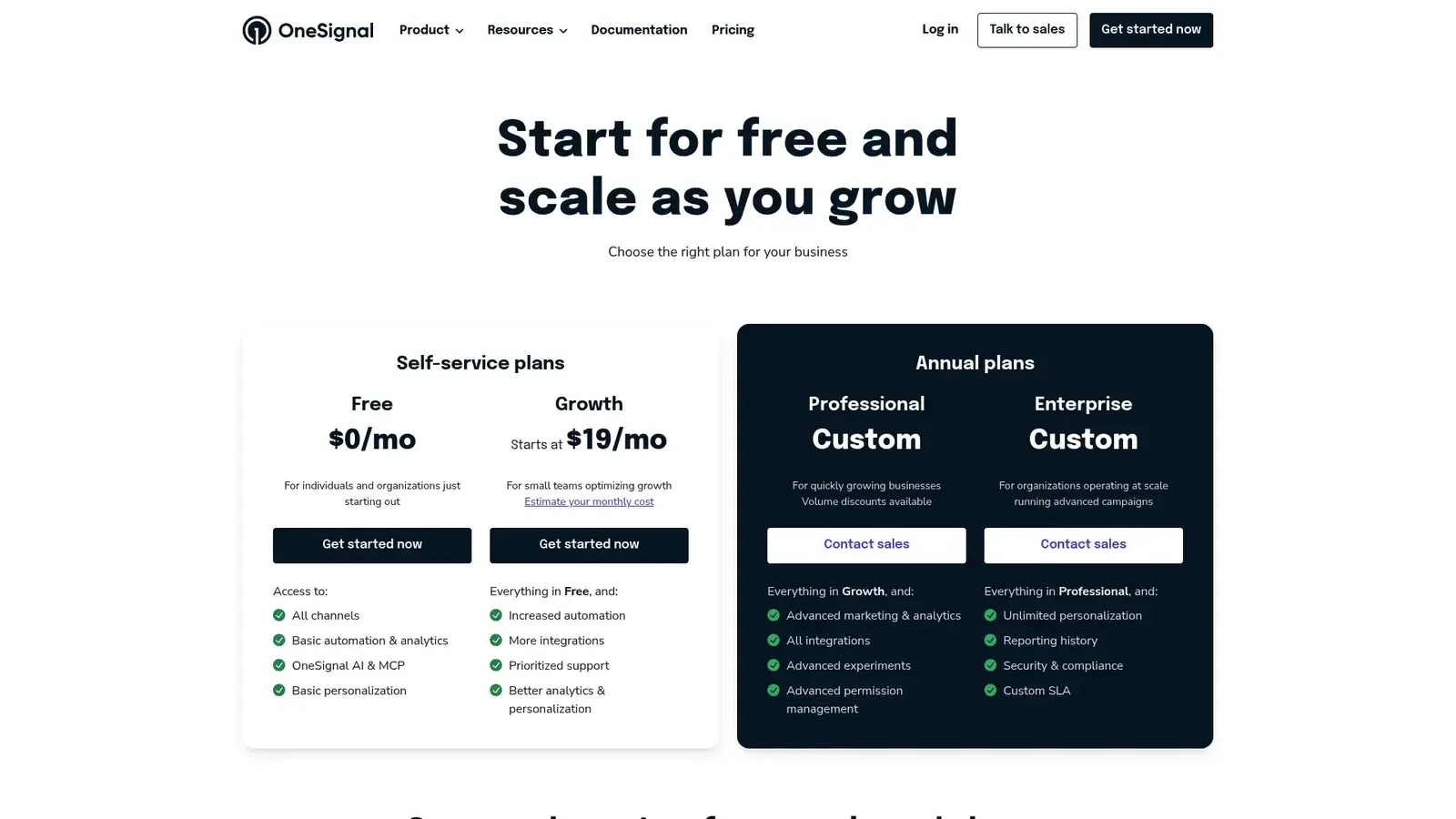
OneSignal publishes self-serve prices. Source: OneSignal, captured November 2026.
OneSignal is where many consumer apps start with push, and it has grown into a multi-channel tool with journeys, email and SMS. Paid plans include unlimited push and in-app messages per active user.
Where OneSignal beats Braze: a free plan, published usage prices and month-to-month billing on Growth.
Where OneSignal falls short: journeys, segmentation and analytics are lighter, and the most useful features sit on annual plans. Personalization uses Liquid, and a missing value renders blank while the message still sends, unless someone adds a fallback.
What reviewers say: OneSignal rates 4.7 out of 5 from 108 reviews on Capterra UK. A broadcast media reviewer who gave it five stars wrote:
It's a great computer program with excellent customer service
A software company reviewer who rated it 4 out of 5, and liked having one API for web, iOS and Android push, warned about cost at scale:
At high volume the pricing climbs quickly…
Choose OneSignal if you want to start small and cheap with push. Choose Trophy instead if you want AI lifecycle marketing agents choosing and writing each message for each user, across email and push.
8. Customer.io
Best for: teams that want published pricing and a flexible workflow builder Pricing: Essentials from $100 a month billed monthly for 5,000 profiles; Premium from $1,000 a month billed yearly; billed on profiles and email volume Channels: email, mobile and web push, in-app, SMS, WhatsApp and LINE
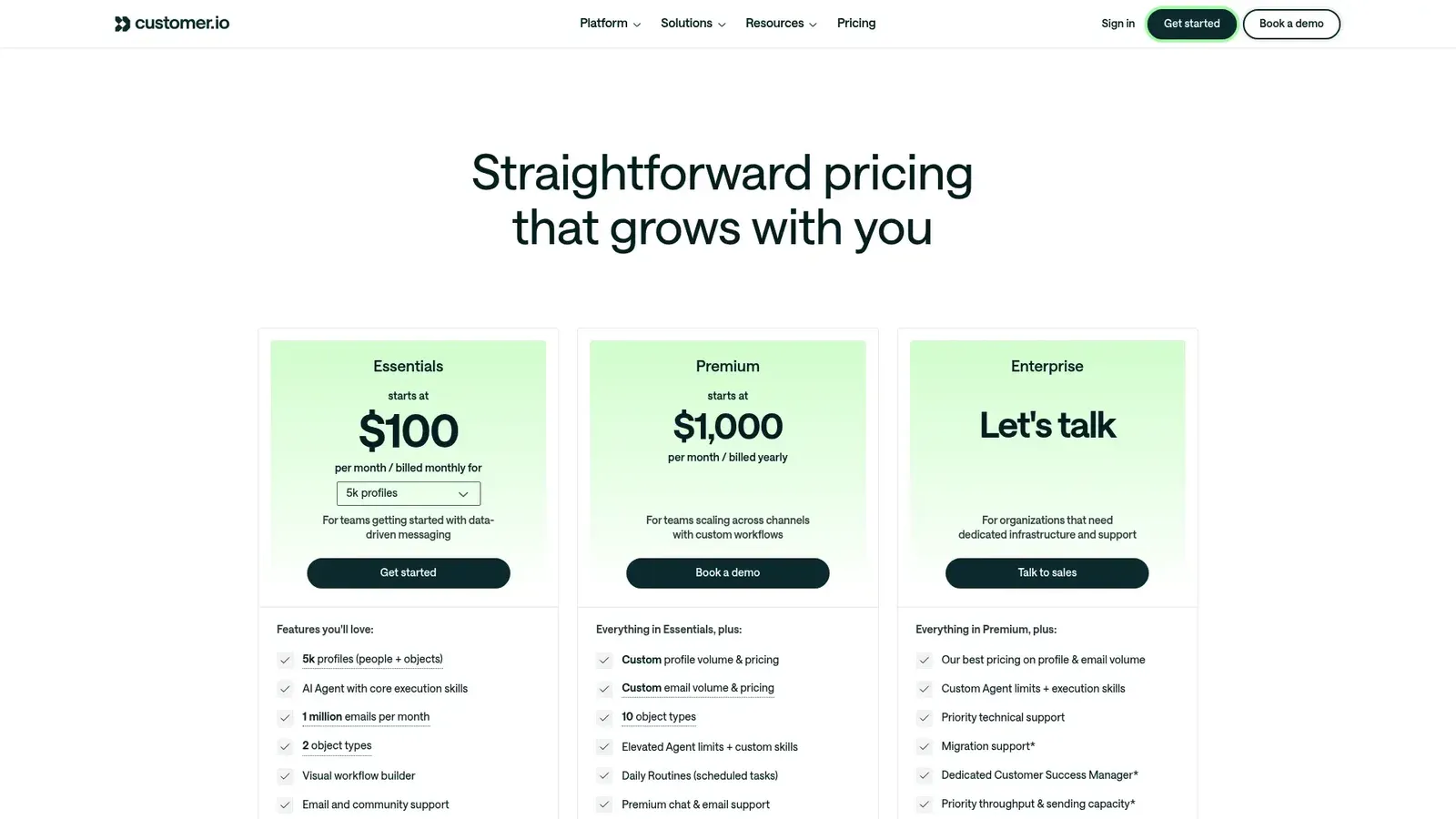
Customer.io publishes starting prices for its plans. Source: Customer.io, captured November 2026.
Customer.io is a flexible, event-driven messaging platform popular with product-led teams, with a visual workflow builder that can include AI steps. Push and in-app messages are unlimited on every plan.
Where Customer.io beats Braze: a visible starting price and month-to-month billing on Essentials.
Where Customer.io falls short: billing counts stored profiles, so lapsed users you keep still cost money, and its plans list A/B tests rather than a holdout group. Messages are personalized in Liquid, and if a statement doesn't evaluate, for example because a profile lacks an attribute and there's no fallback, the message isn't sent.
What reviewers say: Customer.io rates 4.6 out of 5 from 106 reviews on Capterra. A customer lifecycle manager who gave it five stars wrote:
I genuinely enjoy the clean UI and the variety of features on the platform.
A growth marketer who rated it 3 out of 5 found the workflows harder going:
The data functions and the somehow difficult interface of campaigns and flow-building
Choose Customer.io if you want to price the tool yourself and build workflows by hand. Choose Trophy instead if you want AI lifecycle marketing agents deciding and writing each message, with uplift proven against a holdout.
9. Hightouch (works alongside Braze)
Best for: data-led teams that want AI decisioning on warehouse data, sending through the platform they already use Pricing: usage-based and sold by quote, with AI decisioning priced on the actions it takes Channels: sends through your existing engagement platform, such as Braze or Iterable
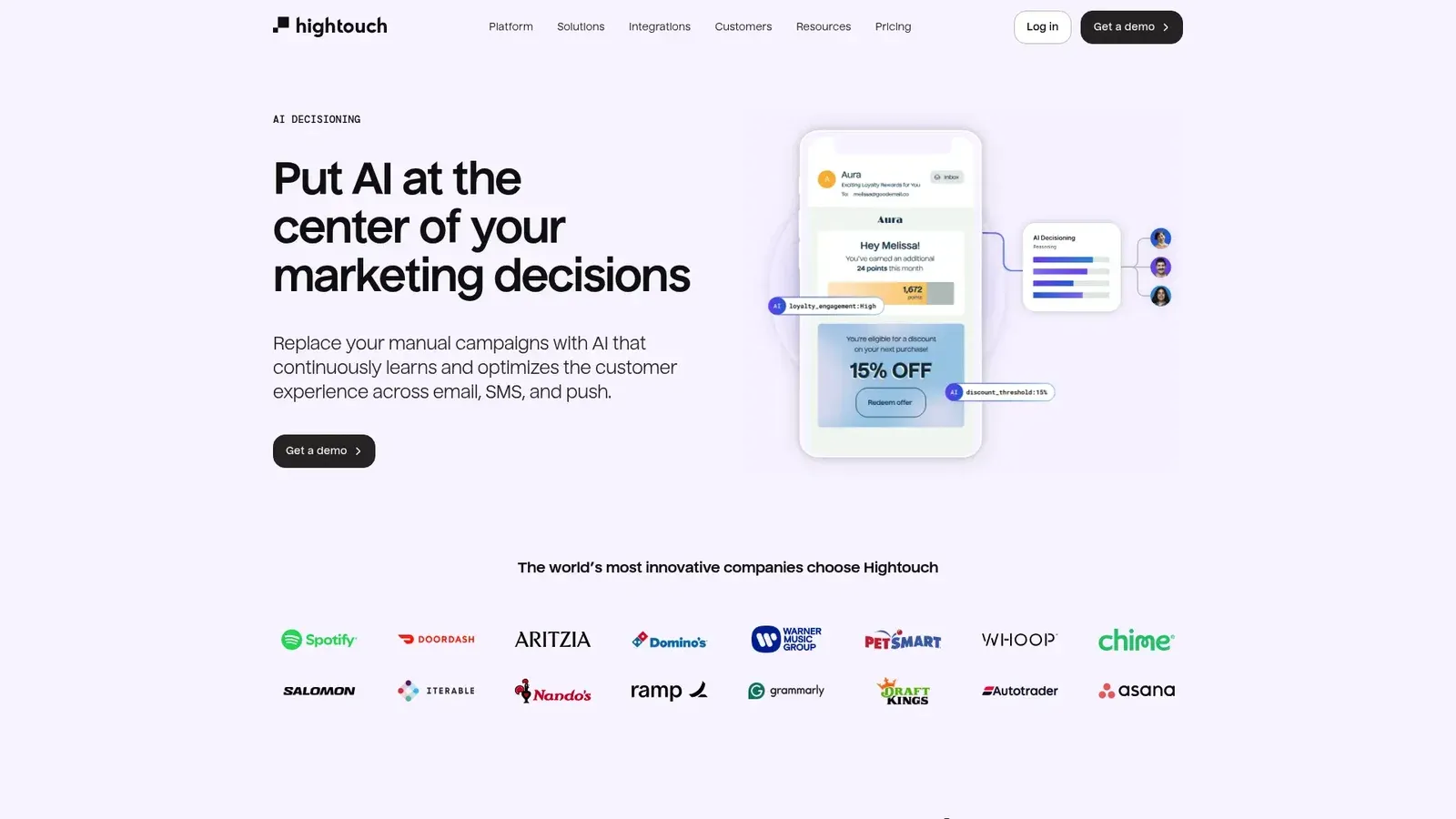
Hightouch's AI Decisioning page. Source: Hightouch, captured November 2026.
Hightouch moves warehouse data into marketing tools and now sells AI Decisioning on top. Its agents send through destinations such as Braze, Iterable and Salesforce Marketing Cloud, so it's less a Braze replacement than a way to add decisioning while keeping Braze for delivery, or to make a later switch easier.
Where Hightouch beats Braze: decisioning on your complete warehouse data without changing your sending platform.
Where Hightouch falls short: you still need a platform to send messages and keep its templates, since your team provides the content Hightouch's agents choose from. Setup sits with your data team.
What reviewers say: Hightouch rates 4.6 out of 5 from 427 reviews on G2. A health and fitness reviewer at a mid-sized company gave it 4.5 stars for a clear interface and AI tools that speed up personalized lifecycle work, with one complaint about which data its agent can see:
Hightouch has helped me connect data that we historically were unable to do ourselves.
A head of marketing and growth at a small business who gave it 3.5 stars valued the clean data it sends to ad platforms, but found the technical side pulled in other teams:
I found it to be quite complicated to use.
Choose Hightouch if you have a strong data team and want to keep your current sender. Choose Trophy instead if you want AI lifecycle marketing agents, sending and in-app experiences in one place.
10. PostHog Workflows (for PostHog users)
Best for: teams already on PostHog analytics that need simple product-triggered messages Pricing: the first 10,000 emails free each month, then from $0.003 per email Channels: email, SMS, push and webhooks
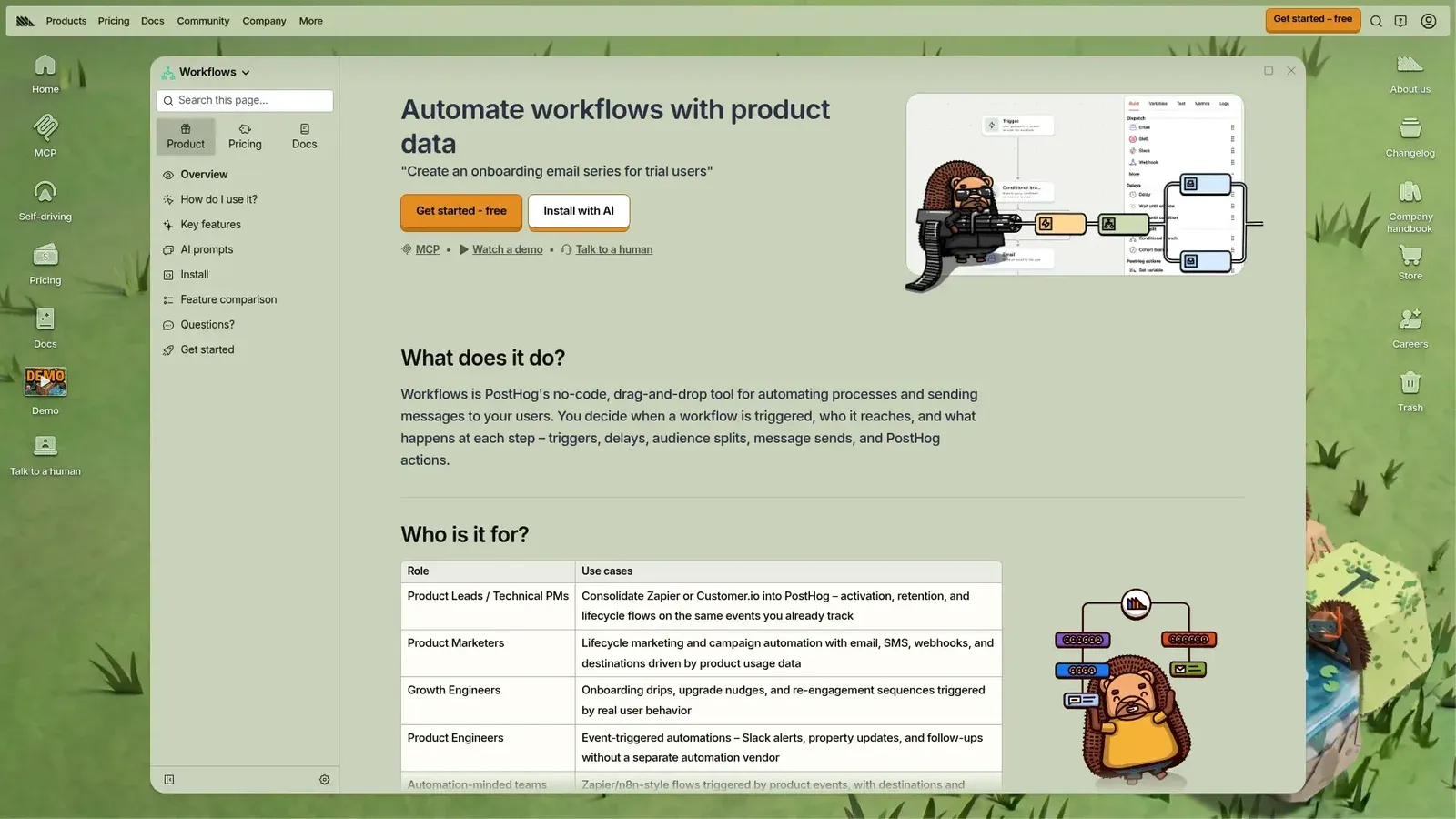
PostHog Workflows runs on events PostHog already tracks. Source: PostHog, captured November 2026.
PostHog Workflows is PostHog's no-code automation tool, built on the events your app already sends to PostHog, and PostHog AI can draft workflows from a prompt.
Where PostHog Workflows beats Braze: no second data pipeline and a free way to start.
Where PostHog Workflows falls short: it describes no per-user decisioning or holdout, in-app messages aren't among its channels, and its message templates use Liquid, where a template that doesn't compile won't send.
Choose PostHog Workflows if you need onboarding flows on events you already track. Choose Trophy instead if you want AI lifecycle marketing agents working for each user individually, delivering the right message at the right time.
How to choose
- Stay on Braze if a dedicated CRM team runs large programs across many channels and the acquisition doesn't change your plans.
- Iterable if your Canvases work and you want an independent platform with a planned migration.
- MoEngage or Insider One for AI decisioning inside a full suite: MoEngage for consumer apps, Insider One for large retailers.
- CleverTap or Airship if your app is the center of engagement.
- OneSignal, Customer.io or PostHog Workflows for published prices and a self-serve start.
- Hightouch to keep Braze for sending and add decisioning on warehouse data.
- Trophy if you want AI lifecycle marketing agents working for each user individually, delivering the right messages at the right time with no journeys or Liquid to maintain, and uplift proven against a holdout.
FAQ
How much does Braze cost?
Braze sells by quote. A contract combines a platform edition, monthly active users and a pool of Action Credits that pays for email, SMS and some AI features, so costs rise with message volume and AI use. OneSignal, Customer.io, CleverTap and PostHog publish starting prices. Our Braze pricing guide covers what buyers report paying and what to check before you renew.
What does it take to switch from Braze?
On another journey platform you rebuild Canvases and SDK work and carry every template across, rewriting Liquid in Handlebars on Iterable or Airship and in Jinja on MoEngage; Iterable plans three to nine months for a multi-channel migration. With Trophy there are no journeys or templates to rebuild. Your engineers send the events you already track, and we run a pilot on a small share of users with a holdout before everyone moves.
How do these platforms compare on security?
Braze, Iterable, Insider One, CleverTap, Customer.io and Hightouch all show SOC 2 and ISO 27001 credentials, and PostHog is SOC 2 Type II certified. Trophy is SOC 2 Type II and ISO 27001 certified, with SSO, MFA and role-based access from the Business plan.
How do I know whether an alternative performs better?
Compare against users who receive nothing. Braze, MoEngage and CleverTap all offer control groups. Trophy holds out a share of users from its AI lifecycle marketing agents from day one, so a pilot shows the incremental uplift on retention and your other KPIs.
What does Braze do better?
Braze covers more channels than any tool here, including RCS, LINE and KakaoTalk, and its Canvases handle complex programs for very large brands. If your CRM team uses that depth, staying is reasonable.
Thinking about your Braze renewal?
If your team spends more time maintaining journeys and Liquid than learning from them, see what AI lifecycle marketing agents do with your data. We'll pilot them on a share of your users against a holdout, judged on your own KPIs.