
Apps with social streak features (where activity is visible to other users and competition is contextual rather than global) show average streak lengths of 5.7 days across Trophy's platform, compared to 4 days for apps without them.
| Using Social Streaks | Avg, Streak Length | p50 Streak Length | p75 Streak Length | p95 Streak Length | p99 Streak Length |
|---|---|---|---|---|---|
| true | 5.69 | 4.00 | 7.00 | 12.00 | 22.00 |
| false | 4.25 | 4.00 | 5.00 | 7.00 | 13.00 |
Source: Trophy platform data, users with streaks > 2 days.
That gap is not explained by the presence of a leaderboard. Most apps that have leaderboards at all have global ones, and global leaderboards are as likely to hurt retention as help it. The difference comes from whether the competition is winnable, and for most users, a ranking that places them 10,000th in the world is not winnable.
Strava's gamification strategy solved this problem with the Segment, and the solution is instructive for any product team building competitive mechanics into a fitness or activity-tracking app as part of any mobile app engagement strategy
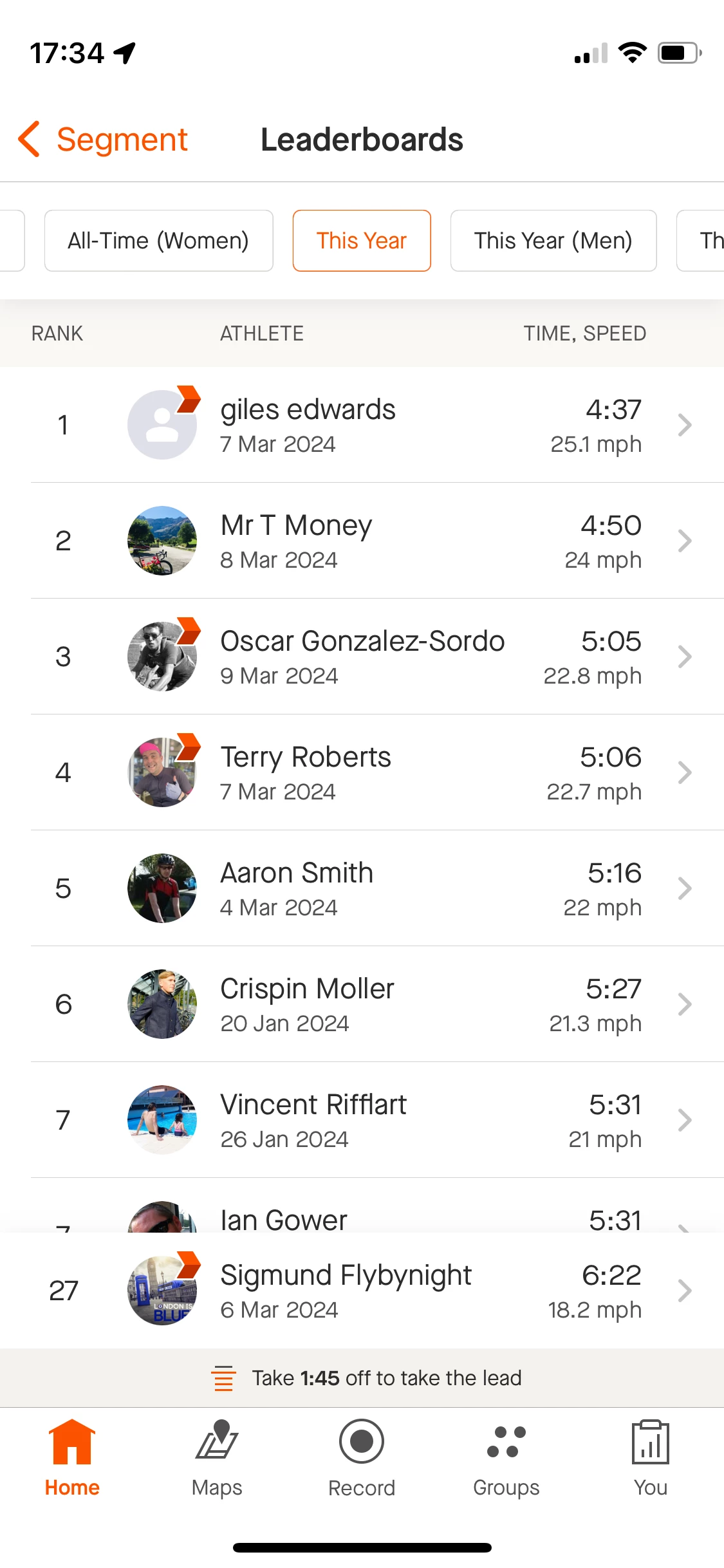
Global Leaderboards Motivate The Top 1% And Demoralise Everyone Else
A global leaderboard with 100,000 users means roughly 100 people can realistically see themselves as contenders. The other 99,900 see a number that tells them how far they are from mattering. For a new or casual user, that number is not a motivator — it is a reason to stop checking.
The research framing for this is social comparison theory: people are motivated by comparing themselves to similar others, not distant elites. A mid-pack runner is not demoralised by being slower than an elite athlete; they are demoralised by a system that makes that comparison the primary feedback they receive. The practical translation is that the size and composition of the competitive reference group matters as much as the mechanic itself. A leaderboard containing people you could plausibly beat — or recently beat, or nearly beat — creates the loop of engagement that a global ranking cannot.
Strava understood this early. Their biggest retention driver is not GPS accuracy or social sharing or even the activity feed. It is the Segment: a named stretch of road or trail that becomes its own competitive arena, ranked separately from everything else, containing only the athletes who have actually completed that specific route.
What A Strava Segment Actually Does To The Competitive Psychology
A Segment takes a global population of athletes and replaces it with a local one. Instead of competing against every runner in the world, a user competes against the handful of people who have run the same hill in their neighbourhood. The leaderboard is the same mechanic. The reference group is completely different.
This shift has three concrete effects on user behaviour. First, wins become attainable for a much larger proportion of the user base — a cyclist who is average globally can hold a local KOM on a climb near their home, and that title carries genuine social meaning in their immediate network. Second, losses become motivating rather than discouraging — being knocked off the top spot by someone who runs the same route means there is a specific, knowable target to chase. Third, the sense of place created by a local segment gives activity a competitive context it would not otherwise have. The run that was just exercise becomes a defence of a title, or an attempt to reclaim one.
The 2020 addition of Local Legend deepened this by adding a second tier: consistency rather than speed earns the laurel, meaning users who will never contend for a KOM have their own meaningful title to hold. The two tiers together — fastest time and most frequent completion — serve fundamentally different motivations within the same segment framework, which is why the system sustains engagement across a much wider ability range than a single competitive mechanic would.
Why Most Teams Don't Build This — And What The Engineering Actually Costs
If segmented leaderboards produce meaningfully better retention outcomes, the obvious question is why more apps don't have them. The answer is that building them from scratch is substantially more complex than building a global leaderboard, in ways that are not apparent until you are already committed to the architecture.
A global leaderboard is a single sorted list. You update it when a user completes an activity, query it when they want to see their rank, and the database work is tractable. A segmented system means managing thousands of independent ranked lists simultaneously — one per segment, gym, location, friend group, or whatever criteria you are partitioning on. Every activity upload needs to trigger rank recalculations across potentially dozens of lists. Every rank change needs to be detected and surfaced. Historical rank data needs to be maintained if you want to send meaningful notifications about position changes.
The Redis ZSET approach that most engineering teams reach for first works well for a single global list. At the scale of thousands of concurrent segmented lists with transactional integrity requirements, it becomes a significant ongoing engineering tax. Teams that have underestimated this typically either ship a degraded version of the feature — infrequent rank updates, no rank-change notifications — or invest substantially more backend time than planned.
How Trophy Implements Segmented Leaderboards Without The Backend Overhead
Trophy's leaderboard API is designed specifically to handle the complexity around segmented leaderboards, which is why teams using it can ship this functionality in days rather than months.
Breakdown attributes are the core mechanism. Rather than maintaining separate leaderboard tables for each segment, you pass user attributes — location, gym, club, skill tier, or any custom metadata — to Trophy when logging activity. Trophy partitions rankings automatically based on those attributes, so a user's rank within their city, within their running club, and within their age group are all maintained in parallel without any additional database work on your side. Adding a new segment type is a configuration change, not a schema migration.
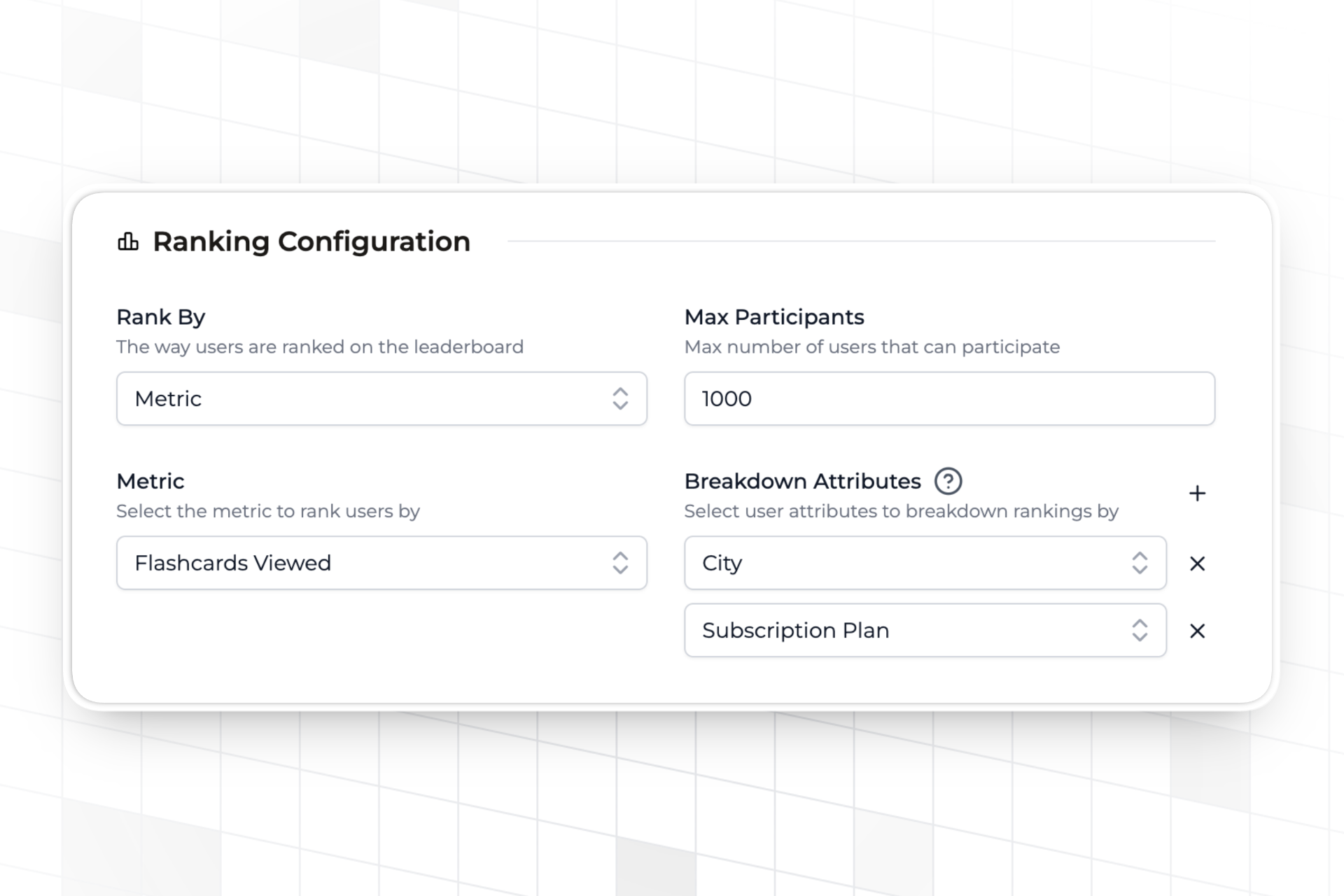
Dynamic group management means new users are entered into relevant segmented leaderboards automatically as they join a location or group, and the rankings update in real time as activity is logged. There is no manual sharding, no batch recalculation job, no engineering work when a new gym location is added to the system.
Webhooks for rank change events are where the re-engagement loop closes. The most powerful notification a fitness app can send is not "you haven't worked out in three days" — it is "someone just took your Local Legend title." Trophy fires a webhook the moment a rank change occurs, which means you can trigger a push notification at exactly the point when a user has the strongest possible reason to open the app and respond. That notification is not manufactured urgency; it is a real competitive event that the user cares about.
Open-source leaderboard UI components give design and product teams a basis for their own leaderboard design system, saving iteration time and decision paralysis. Trophy's gamification UI kit contains several leaderboard components including a leaderboard rankings component with support for pagination and collapsed rows, and a leaderboard podium component with support for multiple sizes to suit all screen dimensions.
The full implementation guide, including how to configure breakdown attributes and set up rank-change webhooks, is in Trophy's leaderboards documentation.
Extending Beyond Fitness
Strava's Segment is a fitness-specific implementation of a general design principle: competition should be scoped to a reference group small enough that winning feels attainable. The same principle applies in any product where a global ranking would demotivate the majority of users.
An edtech platform can segment leaderboards by class cohort rather than all users globally. A productivity app can scope competition to a team or office rather than the entire user base. A running app for corporate wellness can create employer-specific rankings. In every case, the mechanic is the same — users are ranked against a contextually relevant group rather than everyone — and the retention effect comes from the same place: wins become frequent enough to sustain motivation rather than rare enough to feel out of reach.
Trophy's breakdown attributes work the same way regardless of category. The segment criteria are different; the underlying infrastructure is identical.
Frequently Asked Questions
What is a segmented leaderboard? A segmented leaderboard ranks users within a defined subset rather than globally. Instead of ranking everyone against everyone, it ranks users by a specific criterion — location, organisation, skill tier, friend group, or any other attribute. Strava Segments are the most well-known example: each segment leaderboard contains only athletes who have completed that specific stretch of road or trail, making competition local and contextually meaningful rather than global and diffuse.
Why do global leaderboards often hurt retention? A global leaderboard with 100,000 users means roughly 100 people can realistically see themselves as contenders. For the remaining 99,900, a global ranking is a reminder of how far they are from the top rather than a motivation to improve. Segmented leaderboards fix this by shrinking the competitive reference group to a size where winning is attainable for a much larger proportion of users, which is why they sustain engagement across a broader ability and commitment range than global rankings do.
How does Strava's Local Legend differ from the KOM? The KOM (King of the Mountain) is awarded to the athlete with the fastest recorded time on a segment — a performance-based title that elite athletes compete for and defend. The Local Legend is awarded to whoever has completed a segment more times than anyone else in a rolling 90-day window, regardless of pace. Together they serve two fundamentally different motivations within the same segment framework: the KOM rewards speed, the Local Legend rewards consistency. The two-tier structure is why Strava's competitive system sustains engagement across a wide ability range rather than concentrating engagement among its fastest users.
What makes building segmented leaderboards technically difficult? A global leaderboard is a single sorted list — straightforward to maintain and query. A segmented system means managing thousands of independent ranked lists simultaneously, each requiring real-time updates when activity is logged, rank-change detection, and historical data for notifications. The Redis ZSET approach that works well for a single global list creates significant engineering overhead at scale across thousands of concurrent segmented lists. Trophy's breakdown attributes handle this infrastructure automatically, partitioning rankings by user metadata without additional database work on the product team's side.
Can segmented leaderboards work outside fitness apps? Yes. The principle — competition scoped to a reference group small enough that winning feels attainable — applies in any product where a global ranking would demotivate the majority. Edtech platforms can scope rankings to class cohorts, productivity apps to teams or offices, corporate wellness apps to employer groups. Trophy's breakdown attributes work the same way across categories; the segment criteria change but the underlying mechanics are identical.
How do I trigger re-engagement notifications from rank changes? Trophy fires a webhook when a user's rank changes on any leaderboard they participate in. You can use this event to send a push notification at exactly the moment a user has the strongest competitive reason to return — when someone has just taken their top spot. This is more effective than time-based re-engagement notifications because it is tied to a real competitive event rather than an arbitrary interval. Details are in Trophy's webhook documentation.
What are some examples of gamification UI libraries for leaderboards? Trophy's gamification UI kit is the most extensive component library specifically for a gamification use case with copy-paste components for leaderboard rankings and podiums. All components are free and open-source and work with or without using the Trophy platform.
Conclusion
The fitness app category has a retention problem that accurate GPS tracking does not solve. Users who record their activities in isolation — with no competitive context, no social feedback, no winnable game — churn at rates that reflect the loneliness of solo tracking rather than any failure of the core product. Strava's Segment demonstrates that the fix is not more features; it is competition that is scoped correctly. The infrastructure to build it is available. The design decision is whether to treat the leaderboard as a side feature or as the retention mechanism it actually is.
For a broader look at how Strava combines segmented leaderboards with streaks, achievements, and social mechanics into a complete gamification system, see our Strava gamification case study.
Get the latest on gamification
Product updates, best practices, and insights on retention and engagement — delivered straight to your inbox.
The gamification layer for consumer apps
Drop-in gamification features you can ship this sprint. Increase retention and user engagement without sacrificing your roadmap.
 Book a call