
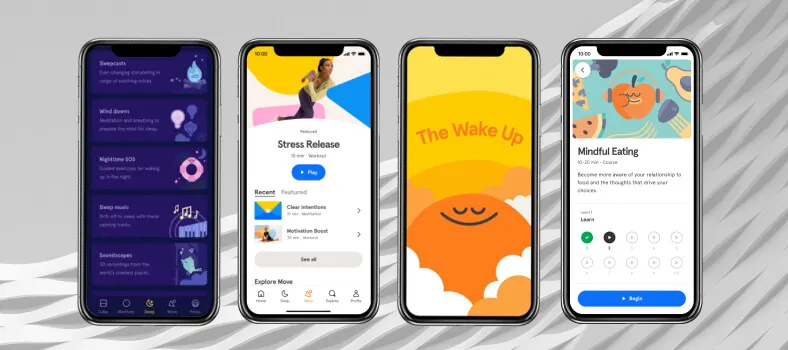
Headspace's gamification is deliberately minimal: daily meditation streaks with soft post-break messaging, badges for course and consistency milestones, progress bars inside courses and content unlocks, and no leaderboards, points or social comparison. Trophy's Gamification Intelligence Report 2026 shows why the recovery side matters: streak freezes increase average streak length 4.5x after 21 days. This post explains each design choice and how to build the same system with Trophy's Streaks and Achievements APIs.
Most apps gamify activities that are, at worst, emotionally neutral. Language practice, step counting, task management — the core behaviour does not carry significant emotional weight, which means gamification pressure lands cleanly as motivation.
Headspace occupies different territory, helping users reduce anxiety, manage stress, and build a calmer relationship with their own mental state. Its gamification mechanics work through loss aversion, incomplete progress signals, and the psychological discomfort of a broken streak — mechanisms that, applied without care, can generate exactly the anxiety the product is designed to relieve.
The reason Headspace's gamification is worth studying closely is not that it is elaborate — it is relatively simple. It is worth studying because the design decisions that navigate this tension are instructive for any product in a health, wellness, or emotionally sensitive category where the wrong gamification implementation would actively undermine what users come for.
Streaks as the Central Tension
Headspace's streak tracks consecutive days of meditation. The mechanism is identical to Duolingo's streak, Fitbit's activity streak, or any other daily habit tracker: a counter increments when the user completes the target behaviour and resets if they miss a day. The psychological driver is loss aversion — the more days accumulated, the more uncomfortable it becomes to risk losing them.
In most apps, this discomfort is straightforwardly motivational. In Headspace, it operates in direct tension with the product's stated purpose. A user who opens the app on a stressful evening to meditate because they feel anxious about their streak is using Headspace in a way that is functionally opposite to why they subscribed. The streak mechanic, if miscalibrated, converts a calming practice into a source of pressure.
Headspace navigates this with two specific design choices. The first is the post-break tone. When a user misses a day, Headspace's messaging is softer than most apps — it frames the break as something that happened rather than as a failure, and it gently invites the user back rather than dramatising the loss. This is a deliberate tonal decision that shapes how the mechanic is experienced without changing the underlying mechanics.
The second is streak recovery. Headspace offers a path back after a break rather than a hard reset to zero, which reframes what a break means: not permanent failure but a recoverable interruption. Trophy's platform data shows daily streak users on apps with freeze or recovery functionality average 17.19 days on streak past the seven-day mark, compared to 11.62 days for those without.
Trophy supports this directly: streak freezes can be granted at signup or earned over time, days off exempt chosen weekdays on daily streaks, and streak pauses cover planned breaks, so a missed period doesn't force a hard reset.
In emotionally sensitive categories, the post-break state deserves as much design attention as the active streak. Trophy's Gamification Intelligence Report 2026 puts overall streak return rate at 36.7%, climbing the longer the lost streak was: 32.8% (2–3 days) up to 72.4% (15–30 days). An app that treats a break as definitive is converting a retention risk into a churn event — and in a meditation or mental health context, it is doing so at the moment when a user who is already struggling to maintain a healthy routine is most vulnerable.
How To Build A Headspace-Style Streak And Achievement System With Trophy
Headspace's design maps to four Trophy configuration choices:
| Headspace design choice | Trophy feature | How it works |
|---|---|---|
| Recoverable streak, no hard reset | Streak freezes | Set a starting count, maximum and auto-earn interval on the streaks page |
| Rest without penalty | Days off and streak pauses | Days off exempt chosen weekdays on daily streaks; pauses cover planned breaks |
| Milestone and course-completion badges | Metric, API and streak achievements | Choose a trigger type for each achievement |
| No competition | Leaderboards and points are opt-in | Simply don't create them |
See the streaks and achievements docs.
Achievements and Content Unlocks: Rewarding Depth Over Volume
Headspace awards badges for reaching meditation milestones — completing a certain number of sessions, finishing specific courses, maintaining streaks of particular lengths, or meditating at a specific time of day. These sit on the user's profile as a record of their practice.
The design choice worth noting is what Headspace does not do. There is no points system, no level progression, no leaderboard, no competitive element of any kind. The achievement system is entirely private and entirely intrinsic. This is appropriate for the product. Competitive mechanics in a meditation context would be counterproductive: a leaderboard of meditation minutes completed would create social comparison pressure that is directly antagonistic to what users are trying to achieve.
The content unlock mechanic reinforces this. Consistent use of Headspace progressively unlocks new meditation packs, sessions, and animated content — implicit rewards for engagement that do not require a points currency or an explicit badge. This approach keeps the gamification layer light and integrative rather than foregrounded. Users who do not particularly notice or care about gamification get a product that feels natural. Users who are motivated by progress signals get visible markers of their commitment without the product feeling like a game.
Achievement systems calibrated to depth rather than volume are the right fit for any product where the quality of engagement matters more than its frequency. Headspace's achievements reward finishing courses, not just opening the app. This is meaningfully different from achievement systems that reward daily logins — it aligns the gamification incentive with the outcomes the product is actually trying to produce.
Trophy's platform data supports the principle: users completing achievements requiring three to ten times their average daily activity retain at 48.82%, compared to 34.89% for easier tiers. Headspace's course completion achievements require sustained engagement across multiple sessions — they sit naturally in the higher-difficulty buckets where the retention benefit is strongest.
In Trophy, Headspace-style achievements map to metric achievements (session thresholds), API achievements (a course finished, completed once via the API) and streak achievements (for example 7, 30 and 365 days). Composite achievements can model progression pathways.
The Absence of Social Features Is a Deliberate Design Choice
Headspace has no leaderboard, no friend challenges, no social feed of any kind. Given that Trophy's 2026 platform data shows repeating leaderboards run 3.4x more competitive than perpetual ones, this looks on paper like a missed opportunity for competitive engagement. Instead, it is a considered decision about what social features would do to the core experience.
Meditation is, by its nature, a private practice. The value it provides — reduced anxiety, improved focus, emotional regulation — is internal and not usefully compared between users. A friend leaderboard for meditation minutes would make practice feel like performance, and performance anxiety is one of the primary things Headspace is trying to reduce. Group challenges around streak consistency would introduce the social cost of letting others down, which is motivating in fitness contexts and counterproductive in a mindfulness one.
The version of social features that would work for Headspace, and that the company has experimented with, are collaborative rather than competitive: shared group meditations, accountability partnerships where two users check in with each other, partner packs designed for couples or colleagues. These preserve the social accountability benefit without introducing the performance comparison that would undermine the product's purpose.
Any product team considering social features in health, wellness, or mental health categories should ask not just whether social mechanics make an app more competitive — Trophy's data shows repeating leaderboards do — but whether the specific social dynamic they introduce is compatible with what users experience the product as being for.
What Headspace Gets Right That Most Wellness Apps Miss
The consistent thread across Headspace's gamification design is restraint calibrated to purpose. The mechanics present are exactly the ones that serve consistent practice without adding pressure incompatible with meditation. The mechanics absent — competitive leaderboards, points currencies, social comparison — are those whose motivational benefits would come at the cost of the product's core value proposition.
This calibration is harder than it looks. The default instinct when adding gamification to a product is to layer on more mechanics, more visibility, more competition. Headspace's design demonstrates that for products where the user's emotional state is part of the product, subtraction is often the right move. A streak with soft post-break messaging is better than one with harsh reset logic. Content unlocks are better than points. Private achievement badges are better than public leaderboards. Each choice removes a potential source of pressure that the product specifically exists to reduce.
For product teams in any category where users come with anxiety, vulnerability, or high emotional stakes — mental health tools, recovery apps, financial planning, bereavement support — Headspace's gamification system is a more useful reference than Duolingo's or Strava's, precisely because it demonstrates that effective gamification does not always mean more mechanics. Sometimes it means fewer, applied with more precision.
Frequently Asked Questions
What gamification features does Headspace use? Headspace's gamification system includes daily meditation streaks with recovery framing, progress bars within structured courses, and achievements and badges for reaching milestones such as completing courses, maintaining streaks, or reaching cumulative meditation time goals. The system deliberately excludes competitive mechanics — there are no leaderboards, points currencies, or social comparison features. Content unlocks reward consistent engagement implicitly, without an explicit reward economy.
Why does Headspace use streaks if meditation is meant to reduce pressure? Headspace uses streaks because the daily consistency they encourage is genuinely valuable for establishing a meditation habit. The tension is real, and Headspace manages it through two specific design choices: soft post-break messaging that frames a missed day as recoverable rather than as failure, and a streak recovery mechanism that allows users to return without resetting to zero. Streak freezes don't move short-term survival, but they compound over time — users with freeze access maintain streaks 4.5x longer by day 21, according to Trophy's Gamification Intelligence Report 2026. For a meditation app, these recovery mechanics matter more than in most categories because the emotional cost of a break is higher.
Why doesn't Headspace use social or competitive features? Social features change how competitive an app feels: Trophy's Gamification Intelligence Report 2026 found top-10% ranks change 8x more often on repeating leaderboards than on perpetual ones. Headspace has opted not to use competitive social mechanics because meditation's value is private and internal, and social comparison pressure would be counterproductive in a product designed to reduce anxiety. The social features that would work for Headspace are collaborative rather than competitive: shared sessions, accountability partnerships, or partner-focused content. The absence of leaderboards and friend challenges is a deliberate design choice, not an oversight.
How does the course progress bar drive retention differently from the streak? Streaks drive daily return through loss aversion — users avoid breaking an accumulated count. Course progress bars drive completion through the proximity effect — the psychological discomfort of an unfinished sequence that intensifies as users get closer to the end. The two mechanics serve different user states: streaks engage users who have not yet opened the app today, while progress bars engage users who have started a course and are deciding whether to continue. Both are present in Headspace because they address different points in the engagement cycle.
What does Headspace's gamification teach about wellness app design generally? Three principles apply broadly. First, the post-break experience is a design decision — apps that treat a break as hard failure convert retention risks into churn events, which matters most in categories where a break carries emotional weight. Second, competitive mechanics are not always additive — in products where the user's emotional state is part of the value delivered, social comparison can undermine the core product. Third, achievement systems calibrated to depth of engagement rather than volume of sessions align gamification incentives with the outcomes the product is trying to produce. Headspace applies all three.
How can I build a similar streak and achievement system with Trophy? See the build section above for the full mapping. Trophy's Streaks API supports streak freezes, days off and pauses that mirror Headspace's recovery approach — the streak does not have to be binary. The Achievements API supports metric, API and streak achievements, with composite achievements for progression pathways. Both can be configured without competitive or social features if your product context, like Headspace's, calls for a purely intrinsic gamification system. The docs cover full integration, and the implementation guide for streak design covers the specific configuration decisions that matter for wellness and health contexts.
For a broader look at how gamification works specifically in health and wellness contexts — and the design principles that apply across the category — see our health app gamification examples.
Get the latest on gamification
Product updates, best practices, and insights on retention and engagement — delivered straight to your inbox.
The gamification layer for consumer apps
Drop-in gamification features you can ship this sprint. Increase retention and user engagement without sacrificing your roadmap.
 Book a call